Vitamin b12 Deficiency: Causes, Risks & Foods.
Vitamin B12 is needed in very small amounts, but its role in the body is anything but small.
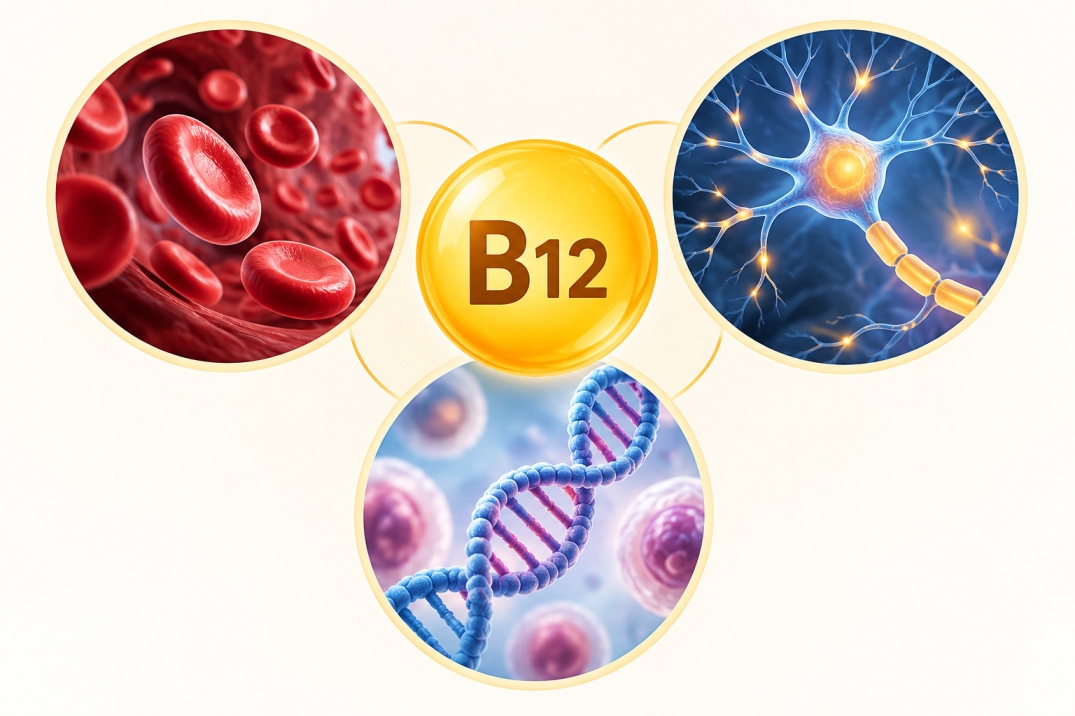
It helps keep red blood cells and nerve cells healthy, supports DNA production and plays an important role in normal cellular function. Vitamin B12 deficiency can lead to megaloblastic anemia and, importantly, can also cause neurological problems.
The challenge is that B12 deficiency does not always announce itself immediately.
Your body stores a relatively large amount of vitamin B12, so symptoms can take years to develop after intake becomes inadequate.
This makes vitamin B12 particularly important for people who:
Eat little or no animal foods
Follow a vegetarian or vegan diet
Are older adults
Have certain digestive conditions
Have undergone some stomach or intestinal surgeries
Take certain medications for prolonged periods
Have problems absorbing vitamin B12
For Indian diets, this topic deserves particular attention. The ICMR-NIN Dietary Guidelines for Indians 2024 identify B12 as one of the nutrients that can be challenging to obtain adequately in vegetarian diets and recommend attention to fortified foods and dietary sources.https://ods.od.nih.gov/factsheets/VitaminB12-Consumer/
So, how do you know if you are at risk?
And more importantly:
What should you eat to get enough vitamin B12?
What Is Vitamin B12?
Vitamin B12, also called cobalamin, is a water-soluble vitamin.
Your body needs it for several important functions, including:
DNA production
Red blood cell formation
Normal nerve function
Cellular metabolism
Maintaining healthy blood and nerve cells
Vitamin B12 also helps prevent megaloblastic anemia, a condition in which red blood cells become abnormally large and underdeveloped.
Unlike many other vitamins, naturally occurring B12 is found primarily in animal-derived foods.
This is why people who eat little or no animal foods need to pay particular attention to fortified foods and/or supplements.https://www.nin.res.in/dietaryguidelines/
How Much Vitamin B12 Do You Need?
For most adults, the recommended daily amount is:
2.4 micrograms (mcg) per day
Requirements are slightly higher during pregnancy and breastfeeding:
Life Stage
Recommended Vitamin B12
Adults
2.4 mcg/day
Pregnant women
2.6 mcg/day
Breastfeeding women
2.8 mcg/day
These are general recommended amounts, not treatment doses for diagnosed deficiency.
An important point is that needing only a few micrograms per day does not mean deficiency is impossible.
Absorption, dietary pattern and individual health conditions all matter.
Why Is Vitamin B12 Important?
1. Supports Healthy Red Blood Cells
Vitamin B12 is required for normal red blood cell production.
When B12 is severely deficient, the body may produce abnormally large red blood cells, resulting in megaloblastic anemia.
This can contribute to:
Fatigue
Weakness
Pale skin
Reduced exercise tolerance
But these symptoms are not specific to B12 deficiency.
Iron deficiency, folate deficiency and many other conditions can also cause fatigue and anemia.
2. Supports Nerve Health
Vitamin B12 is essential for normal nervous-system function.
Deficiency can cause neurological symptoms such as:
Tingling
Numbness
Problems with balance
Weakness
Memory or concentration problems
One important reason not to ignore B12 deficiency is that neurological damage can occur even without obvious anemia.
3. Helps Make DNA
B12 is involved in DNA synthesis.
This is particularly important for tissues and cells that divide rapidly, including cells involved in blood formation.
4. Supports Normal Cellular Metabolism
Vitamin B12 works with other nutrients in metabolic pathways that help your body process nutrients and maintain normal cellular function.
It is not, however, a magic "energy booster."
If you already have adequate B12, taking extra B12 does not provide a special energy or athletic-performance benefit.
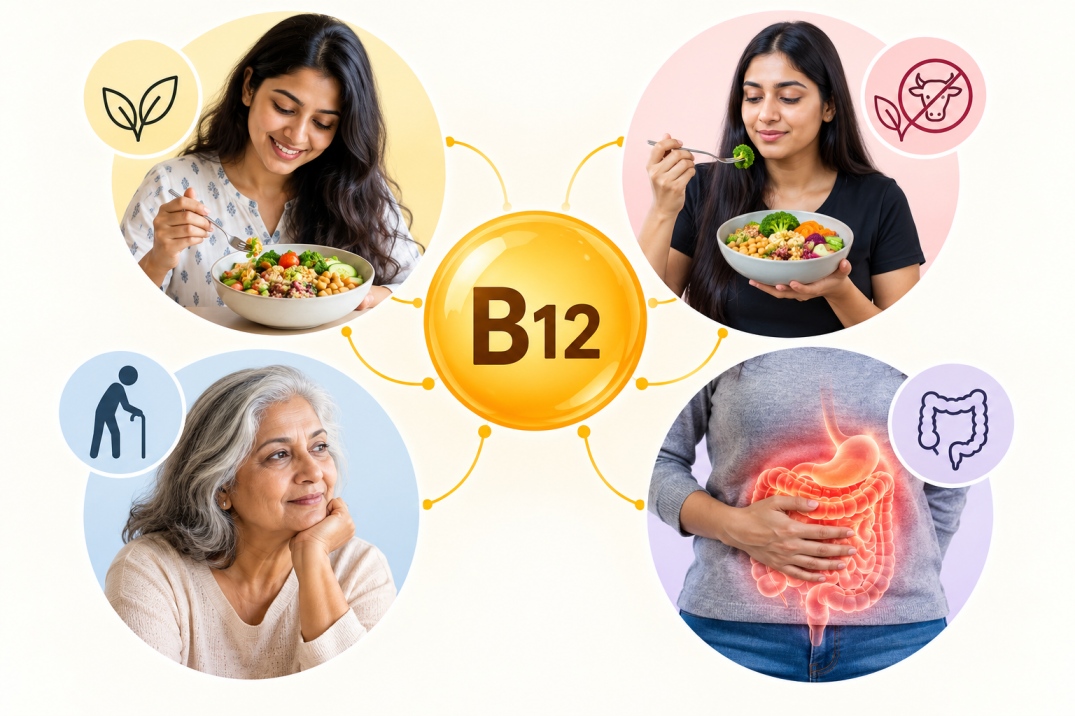
Who Is at Risk of Vitamin B12 Deficiency?
Not everyone has the same risk.
The major risk groups include:
Vegetarians and vegans
Older adults
People with absorption problems
People with pernicious anemia
People who have undergone certain gastrointestinal surgeries
People with certain gastrointestinal disorders
People taking certain medications for prolonged periods
Let's look at each group.
1. Vegetarians and Vegans
This is particularly relevant to Indian nutrition.
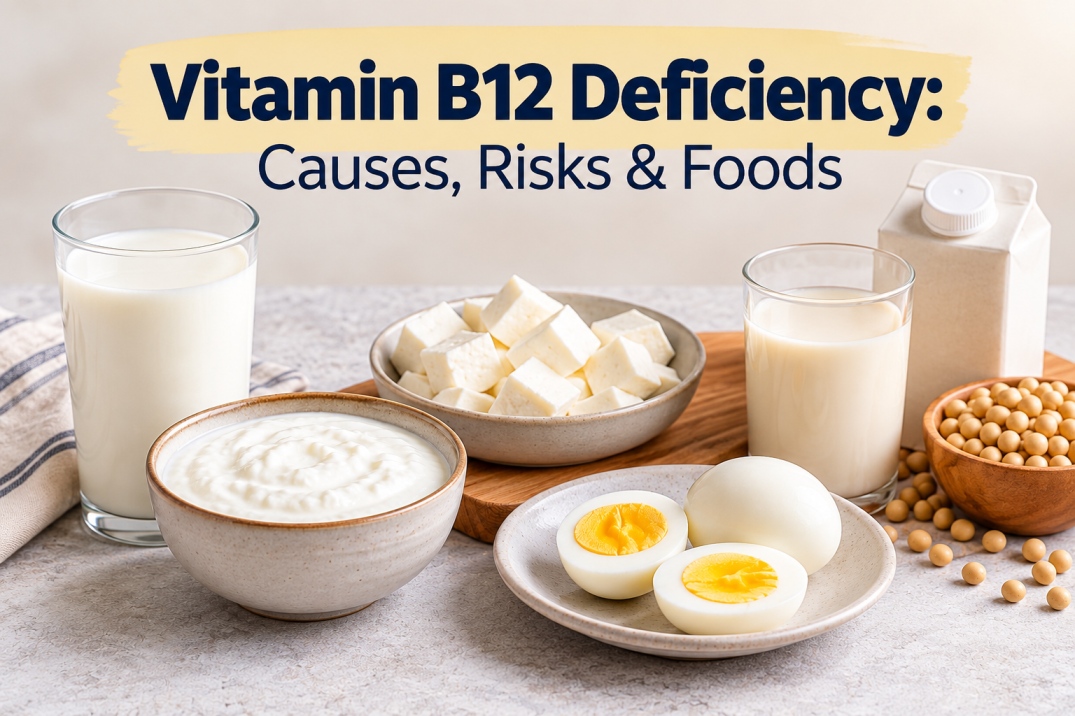
Vitamin B12 is naturally present in animal foods such as:
Milk
Curd
Paneer
Eggs
Fish
Meat
Poultry
Plant foods do not naturally provide reliable vitamin B12 unless they are fortified.
This means:
Lacto-vegetarians
People who consume milk and dairy have some dietary B12 sources, but intake may still be inadequate depending on the overall diet.
Vegans
People who completely avoid animal foods generally need a reliable source of B12 from fortified foods and/or supplements.
ICMR-NIN similarly identifies B12 as a nutrient of concern in vegetarian diets.
2. Older Adults
Vitamin B12 absorption can become less efficient with age.
Older adults may produce less stomach acid, which can make it harder to release B12 naturally bound to food proteins.
For this reason, the NIH Office of Dietary Supplements recommends that adults over 50 obtain most of their B12 from fortified foods and/or supplements because these forms may be easier to absorb than naturally occurring food-bound B12.
This does not mean older adults should stop eating B12-containing foods.
It means absorption deserves attention as well as intake.
3. People With Pernicious Anemia
Pernicious anemia is an autoimmune condition in which the body cannot make enough intrinsic factor, a protein required for vitamin B12 absorption.
Without adequate intrinsic factor, B12 absorption becomes impaired.
Treatment therefore often requires medically supervised B12 therapy.
4. People With Gastrointestinal Disorders
Some conditions affecting the stomach or small intestine can interfere with B12 absorption.
Examples include:
Celiac disease
Crohn's disease
Atrophic gastritis
Other disorders affecting digestion or absorption
In these situations, simply increasing B12-rich foods may not completely solve the problem.
5. People Who Have Had Certain Gastrointestinal Surgeries
Some surgeries involving the stomach or intestine can reduce the body's ability to absorb B12.
This includes certain procedures performed for:
Weight loss
Stomach disease
Removal of part or all of the stomach
Such individuals may require ongoing monitoring and supplementation according to medical advice.
6. People Taking Certain Medications
Some medications can interfere with B12 absorption.
Two important examples are:
Metformin
Metformin, commonly used for diabetes and prediabetes, can reduce B12 absorption and lower blood B12 levels in some people.
Acid-Reducing Medicines
Long-term use of certain gastric-acid-lowering medicines can interfere with the release of B12 from food and contribute to deficiency.
This does not mean you should stop prescribed medication.
If you use these medicines long term and have risk factors or symptoms, discuss B12 testing with your healthcare professional.
What Are the Symptoms of Vitamin B12 Deficiency?
B12 deficiency can develop slowly.
Possible symptoms include:
Persistent fatigue
Weakness
Pale skin
Reduced appetite
Unexplained weight loss
Headaches
Heart palpitations
Numbness
Tingling in the hands or feet
Balance problems
Memory difficulties
Confusion
Mood changes
Sore tongue
Mouth soreness
Neurological symptoms are particularly important because prolonged B12 deficiency can damage the nervous system.

B12 Deficiency and Fatigue
Fatigue is one of the symptoms commonly associated with B12 deficiency.
But fatigue alone does not prove that you are deficient.
Other possible causes include:
Iron deficiency
Folate deficiency
Thyroid disorders
Sleep problems
Inadequate calorie intake
Stress
Infections
Other medical conditions
Therefore:
Do not assume that every episode of tiredness requires a B12 supplement.
If fatigue is persistent or unexplained, appropriate medical evaluation is more useful.
B12 Deficiency and Numbness or Tingling
Numbness or tingling in the hands and feet can be an important warning sign.
This may occur because B12 is required for normal nervous-system function.
However, many other conditions can cause similar symptoms.
If you experience persistent or worsening numbness, tingling, weakness or balance problems, seek medical evaluation rather than self-treating based on symptoms alone.
Can B12 Deficiency Affect the Brain?
Severe or prolonged B12 deficiency can affect neurological function.
Possible symptoms include:
Poor memory
Confusion
Difficulty concentrating
Balance problems
Mood changes
Importantly, neurological problems can occur even without obvious anemia.
This is one reason early recognition and treatment are important.
Why Can B12 Deficiency Take Years to Appear?
Unlike some water-soluble vitamins, the body stores a substantial amount of vitamin B12.
The NIH notes that the body stores approximately 1,000–2,000 times the amount typically consumed in one day, so symptoms can take several years to develop after intake or absorption becomes inadequate.
This can make B12 deficiency easy to overlook.
Someone may have been following a low-B12 diet for a long time before symptoms become noticeable.
Where Does Vitamin B12 Come From?
Naturally occurring vitamin B12 is found primarily in animal-derived foods.
Useful food sources include:
Dairy
Milk
Curd
Paneer
Cheese
Eggs
Eggs contain B12 and can be useful for people who include them.
Fish and Seafood
Fish and seafood can provide substantial amounts of B12.
Meat and Poultry
Meat and poultry are reliable B12 sources.
Fortified Foods
Some foods have vitamin B12 added to them.
These may include:
Fortified breakfast cereals
Fortified plant-based milk
Nutritional yeast
Other fortified foods
Always check the nutrition label because not every plant-based product or cereal contains B12.
Best Vitamin B12 Sources for Indian Vegetarians
For a lacto-vegetarian Indian diet, practical sources include:https://wellorafit.com/services/nutrition-diet-planning/
1. Milk
Milk naturally contains vitamin B12.
It can be included as:
Plain milk
Milk in breakfast
Unsweetened milk-based beverages
ICMR-NIN specifically notes that milk contains a small amount of B12.
2. Curd
Curd provides B12 and can be easily incorporated into Indian meals.
Try:
Curd with lunch
Plain curd as a snack
Curd with vegetable meals
Homemade curd where appropriate
3. Paneer
Paneer contains vitamin B12 along with protein and calcium.
It can be used in:
Paneer bhurji
Palak paneer
Paneer tikka
Paneer vegetable curry
However, paneer should not be considered a concentrated B12 supplement.
The amount you obtain depends on the portion and product.
4. Eggs
For vegetarians who consume eggs, eggs provide B12.
They can be included as:
Boiled eggs
Egg bhurji
Vegetable omelette
Egg sandwich
5. Fortified Foods
Fortified foods can be particularly important for vegetarians and vegans.
Look for products that specifically state:
"Vitamin B12 fortified"
or list vitamin B12 in the nutrition information.
Possible examples include:
Fortified plant-based milk
Fortified breakfast cereals
Fortified nutritional yeast
Other fortified foods
Not every product in these categories is fortified, so check the label rather than assuming.
What About Plant-Based Foods?
This is one of the most important points in the article:
Most ordinary plant foods are not reliable natural sources of vitamin B12.
Foods such as:
Dal
Rajma
Chickpeas
Spinach
Fruits
Vegetables
Nuts
Seeds
Whole grains
are highly nutritious, but they should not be counted as reliable B12 sources unless they are specifically fortified.
This is why a vegan diet requires deliberate planning for B12.https://wellorafit.com/services/nutrition-diet-planning/
What About Spirulina and Seaweed?
These foods are sometimes promoted online as "natural B12 sources."
The problem is that the B12-like compounds found in some algae and similar products may not reliably provide biologically active vitamin B12.
Therefore, they should not be relied upon as the sole B12 source for preventing or treating deficiency.
For a vegan diet, a reliably fortified food or appropriate supplement is a much more dependable strategy.
Vitamin B12 Food Sources at a Glance
Food
B12 Source?
Suitable for
Milk
Yes
Lacto-vegetarians
Curd
Yes
Lacto-vegetarians
Paneer
Yes
Lacto-vegetarians
Eggs
Yes
Ovo-vegetarians
Fish
Yes
Non-vegetarians
Meat
Yes
Non-vegetarians
Fortified plant milk
If fortified
Vegetarians/Vegans
Fortified cereal
If fortified
Vegetarians/Vegans
Nutritional yeast
If fortified
Vegetarians/Vegans
Dal
Not a reliable natural B12 source
Vegetarian diet
Spinach
Not a reliable natural B12 source
Vegetarian diet
Fruits
Not a reliable natural B12 source
Vegetarian diet
Nuts/seeds
Not a reliable natural B12 source
Vegetarian diet
Can a Vegetarian Diet Provide Enough B12?
This depends on the type of vegetarian diet.
Lacto-Vegetarian
Milk and dairy provide some B12, but intake may still be inadequate depending on quantity and overall dietary pattern.
Vegetarian Who Eats Eggs
Eggs add another B12 source.
Vegan
A vegan diet generally needs a deliberate B12 strategy through fortified foods and/or supplements because ordinary plant foods do not naturally provide reliable B12.
This is not a reason to avoid a vegetarian or vegan diet.
It is simply a nutrient that needs to be planned.
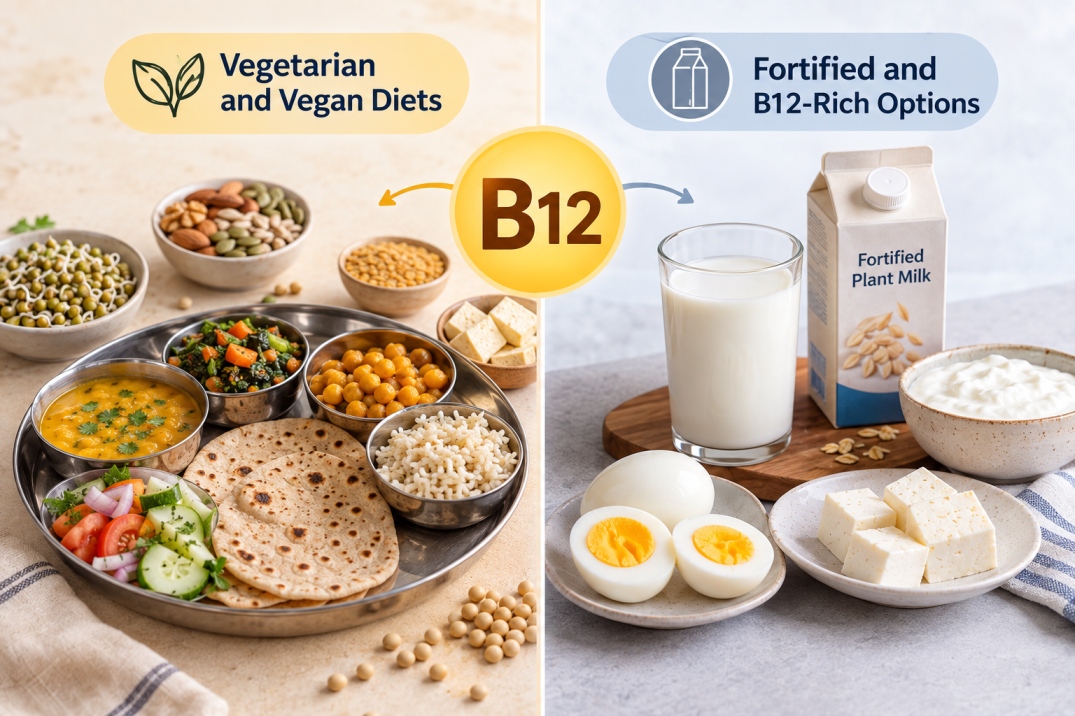
What Should a Vegetarian Eat for B12?
A practical Indian vegetarian approach can include:
Breakfast
Oats or whole-grain breakfast + milk or fortified plant milk
Mid-Morning
Fruit + curd
Lunch
Roti + dal + sabzi + curd
Evening
Fortified beverage or another appropriate B12-containing food
Dinner
Vegetable + roti/rice + paneer/tofu + curd
However, remember that tofu and most ordinary plant foods are not naturally reliable B12 sources unless fortified.
The exact amount of B12 obtained from a diet depends on the specific products and portions.
Can Food Alone Correct B12 Deficiency?
This depends on why the deficiency developed and how severe it is.
If someone simply has inadequate dietary intake, increasing reliable B12 sources may help.
But if deficiency is caused by:
Pernicious anemia
Malabsorption
Gastrointestinal disease
Certain surgeries
Medication-related absorption problems
food alone may not be sufficient.
Treatment can involve oral supplements or injections depending on the cause and severity.
Therefore:
A diagnosed B12 deficiency should be managed appropriately rather than treated only through food.
Do You Need a B12 Supplement If You Are Vegetarian?
Not every vegetarian automatically needs the same supplementation plan.
However, people who consume little or no animal food need to ensure a reliable source.
For vegans, fortified foods and/or supplements are particularly important because ordinary plant foods do not naturally provide B12. (Odyssey Database System)
For older adults and people with absorption problems, supplements or fortified foods may also be useful because B12 from these sources may be easier to absorb than food-bound B12. (Odyssey Database System)
The appropriate supplement dose depends on individual circumstances.
What About Different Forms of B12 Supplements?
Vitamin B12 supplements are available in several forms, including:
Cyanocobalamin
Methylcobalamin
Adenosylcobalamin
Hydroxocobalamin
The NIH notes that research has not established one supplemental form as clearly superior to the others.
Therefore, supplement selection should not be based solely on marketing claims such as:
"This is the most active form."
For diagnosed deficiency, follow the treatment recommended by your healthcare professional.
Are High-Dose B12 Supplements Dangerous?
Vitamin B12 does not have an established upper intake limit because it has a low potential for toxicity, and high-dose supplements are commonly used in clinical settings.
However, that does not mean everyone needs a high-dose supplement.
A supplement should have a purpose:
Confirmed deficiency
High-risk dietary pattern
Increased requirement
Absorption problem
Medical recommendation
Taking multiple supplements unnecessarily is not a substitute for good nutrition.
Does B12 Give You More Energy?
This is one of the biggest B12 marketing claims.
Vitamin B12 is essential for normal energy metabolism, but taking extra B12 does not provide a special energy boost if you already have adequate B12.
If B12 deficiency is causing anemia or other problems, correcting the deficiency may improve symptoms.
But if your B12 status is already adequate:
More B12 does not equal more energy.
Vitamin B12 and Weight Loss
B12 is often marketed as a "weight-loss vitamin."
That claim is misleading.
Vitamin B12 is important for normal metabolism, but B12 supplements do not directly burn body fat.
If someone has B12 deficiency, treating it can help correct deficiency-related symptoms and support normal physiological function.
But B12 supplementation should not be promoted as a fat-burning treatment.
For sustainable weight loss, focus on:
Appropriate calorie intake
Adequate protein
Fiber-rich foods
Vegetables and fruits
Regular physical activity
Sleep
Stress management
B12 and Hair, Skin and Nails
You may see B12 supplements promoted for "glowing skin" or better hair.
Severe nutritional deficiencies can affect many aspects of health, but there is not enough evidence to recommend B12 supplements simply as a cosmetic treatment for people who are not deficient.
If you have unexplained hair loss, brittle nails or skin changes, consider the broader picture—including iron, thyroid function, protein intake and other possible causes.
How Is Vitamin B12 Deficiency Diagnosed?
Symptoms alone are not enough.
A healthcare professional may consider:
Vitamin B12 blood level
Complete blood count
Mean corpuscular volume (MCV)
Methylmalonic acid in selected cases
Homocysteine in selected cases
Other tests based on symptoms and medical history
The exact tests depend on the individual.
If symptoms suggest B12 deficiency, professional evaluation is preferable to taking supplements blindly.
Can B12 Deficiency Exist Without Anemia?
Yes.
This is a particularly important point.
B12 deficiency can cause neurological problems even when a person does not have megaloblastic anemia.
Therefore, a normal haemoglobin level does not necessarily rule out every B12-related problem.
This is one reason risk factors and symptoms should be considered alongside laboratory results.
B12 and Iron Deficiency Are Not the Same
Both deficiencies can cause fatigue.
But they are different nutrients with different functions.
Vitamin B12 Deficiency
Iron Deficiency
Can affect red blood cell formation
Can affect haemoglobin production
Can cause neurological symptoms
Neurological symptoms are not the typical hallmark
Can cause numbness/tingling
Can cause fatigue and weakness
Common risk in low-animal-food diets
Common risk with blood loss and inadequate intake
Requires B12-containing foods/supplements
Requires iron-rich foods and/or iron treatment
Because symptoms overlap, laboratory assessment can be important.
Common B12 Mistakes in Vegetarian Diets
1. Assuming Milk Automatically Provides Enough
Milk contains B12, but depending on the overall diet, the amount may not be sufficient to meet needs.
ICMR-NIN specifically notes that milk has a small amount of B12 while identifying B12 as a nutrient of concern for vegetarians.
2. Counting Dal as a B12 Food
Dal is excellent for protein, fiber and other nutrients.
But ordinary dal is not a reliable natural source of vitamin B12.
3. Assuming All Plant Milk Contains B12
Some plant milks are fortified.
Others are not.
Always check the label.
4. Relying on Spirulina or Seaweed
These are not dependable B12 sources for preventing or treating deficiency.
5. Waiting for Symptoms
B12 deficiency can develop slowly, and symptoms may appear only after a prolonged period of inadequate intake or absorption.
6. Taking Random Injections
B12 injections can be medically appropriate in certain cases, but they should be used based on clinical need rather than social-media recommendations.
How to Read a B12 Food Label
When buying a fortified food, look for:
Vitamin B12
on the nutrition panel.
Do not assume a product contains B12 simply because it says:
Plant-based
Vegan
Healthy
High-protein
Multigrain
Fortified
The word fortified only tells you that something has been added; check which nutrient has actually been added.
A Practical B12 Strategy for Indian Vegetarians
Think about your diet in three categories.
If You Eat Dairy
Include regular sources such as:
Milk
Curd
Paneer
and discuss B12 testing or supplementation if you have risk factors.
If You Eat Eggs
Eggs can provide an additional B12 source.
If You Eat No Animal Foods
Use a reliable B12-fortified food and/or an appropriate supplement.
This is much more dependable than trying to obtain B12 from ordinary vegetables, fruits, grains or legumes.
A Simple B12-Supportive Vegetarian Day
This is an example of food choices, not a treatment plan for diagnosed deficiency.
Breakfast
Oats + milk or B12-fortified plant milk
Mid-Morning
Fruit + curd
Lunch
2 rotis + dal + vegetable + curd
Evening
B12-fortified beverage or another fortified food, if required
Dinner
Paneer/tofu vegetable preparation + roti + vegetables
For a vegan version, replace dairy foods with appropriately fortified products and use a reliable B12 supplement strategy when needed.
What Vegetarians Should Remember About B12
A vegetarian diet can be rich in:
Fiber
Protein
Folate
Potassium
Magnesium
Antioxidants
Plant compounds
But B12 is different.
It is one nutrient that deserves deliberate attention because reliable natural B12 sources are concentrated in animal foods.
ICMR-NIN specifically highlights B12 as a nutrient that can be challenging for vegetarians and recommends attention to fortified sources.
This is a good example of why a healthy diet is not simply about eating more fruits and vegetables.
It is about meeting all essential nutrient requirements.
Key Takeaways
Vitamin B12 is essential for red blood cell formation, DNA production and normal nerve function.
Most adults need about 2.4 mcg of B12 per day.
B12 deficiency can cause megaloblastic anemia and neurological problems.
Symptoms can include fatigue, weakness, pale skin, numbness, tingling, balance problems and cognitive changes.
B12 deficiency can occur without obvious anemia.
Vegetarians and especially vegans are at increased dietary risk because ordinary plant foods do not naturally provide reliable B12.
Milk, curd, paneer and eggs can provide B12 for people who consume them.
Fortified plant milks, breakfast cereals and nutritional yeast can provide B12 when they are specifically fortified.
Older adults may have difficulty absorbing food-bound B12.
Pernicious anemia and certain gastrointestinal disorders can impair B12 absorption.
Some medications, including metformin and long-term acid-reducing medicines, can affect B12 status.
B12 is not a magic energy or weight-loss supplement.
Diagnosed deficiency may require supplements or injections depending on the cause.
A vegetarian diet can be healthy and nutritionally complete, but B12 needs deliberate planning.
Conclusion
Vitamin B12 is a perfect example of a nutrient that is needed in a very small amount but can have a major impact on health.
For most adults, the recommended amount is only 2.4 mcg per day, yet inadequate intake or poor absorption over time can lead to serious consequences, including anemia and neurological problems.
For Indian vegetarians, the most important lesson is not:
"You must stop being vegetarian."
It is:
"You need a reliable source of vitamin B12."
If you consume dairy, foods such as milk, curd and paneer can contribute B12.
If you eat eggs, they provide another dietary source.
If you follow a vegan diet, ordinary plant foods are not a dependable source, so appropriately fortified foods and/or supplements become particularly important.
And if you have symptoms, risk factors or a confirmed deficiency, don't rely on food alone without understanding the cause.
Good nutrition is not about following the most restrictive diet. It is about meeting your body's nutritional requirements in a way that is practical, sustainable and appropriate for you.
FAQ
1. What are the symptoms of vitamin B12 deficiency?
Symptoms may include fatigue, weakness, pale skin, appetite loss, numbness, tingling, balance problems, memory difficulties, confusion and a sore mouth or tongue.
2. Who is most at risk of B12 deficiency?
Vegetarians and vegans, older adults, people with absorption disorders, people with pernicious anemia, those who have had certain gastrointestinal surgeries, and some people taking long-term metformin or acid-reducing medications are at higher risk.
3. Can vegetarians get enough vitamin B12?
Yes, but B12 needs deliberate planning. Dairy and eggs can contribute B12, while fortified foods and supplements may be needed depending on the dietary pattern and individual risk.
4. Can vegans get B12 from vegetables?
No. Ordinary vegetables, fruits, pulses, grains, nuts and seeds are not reliable natural sources of vitamin B12. Vegans should use reliable fortified foods and/or supplements.
5. Does milk contain vitamin B12?
Yes. Milk contains vitamin B12, although the amount is relatively small. ICMR-NIN specifically identifies milk as a B12 source while noting B12 as a nutrient of concern for vegetarian diets.
6. Is paneer a good source of B12?
Paneer contains vitamin B12 and can contribute to intake, but it should not automatically be considered sufficient to prevent deficiency.
7. Does curd contain B12?
Yes, dairy products including yogurt/curd contain vitamin B12. The amount varies by product.
8. Can B12 deficiency cause hair loss?
B12 deficiency may be associated with some health changes, but hair loss has many causes. It should not automatically be attributed to B12 deficiency.
9. Does vitamin B12 help with weight loss?
B12 is essential for normal metabolism, but supplementation does not directly burn fat or cause weight loss in people who already have adequate B12.
10. Can B12 deficiency cause numbness?
Yes. Numbness and tingling can occur because B12 is important for normal nerve function.
11. Can B12 deficiency exist without anemia?
Yes. Neurological problems can occur even when megaloblastic anemia is not present.
12. Should I take a B12 supplement without testing?
Not everyone needs the same supplementation approach. If you have risk factors or symptoms, discuss appropriate testing and supplementation with a healthcare professional.
Ready to Begin Your Health Journey?
Get a personalized, medically guided plan built around your unique biology.