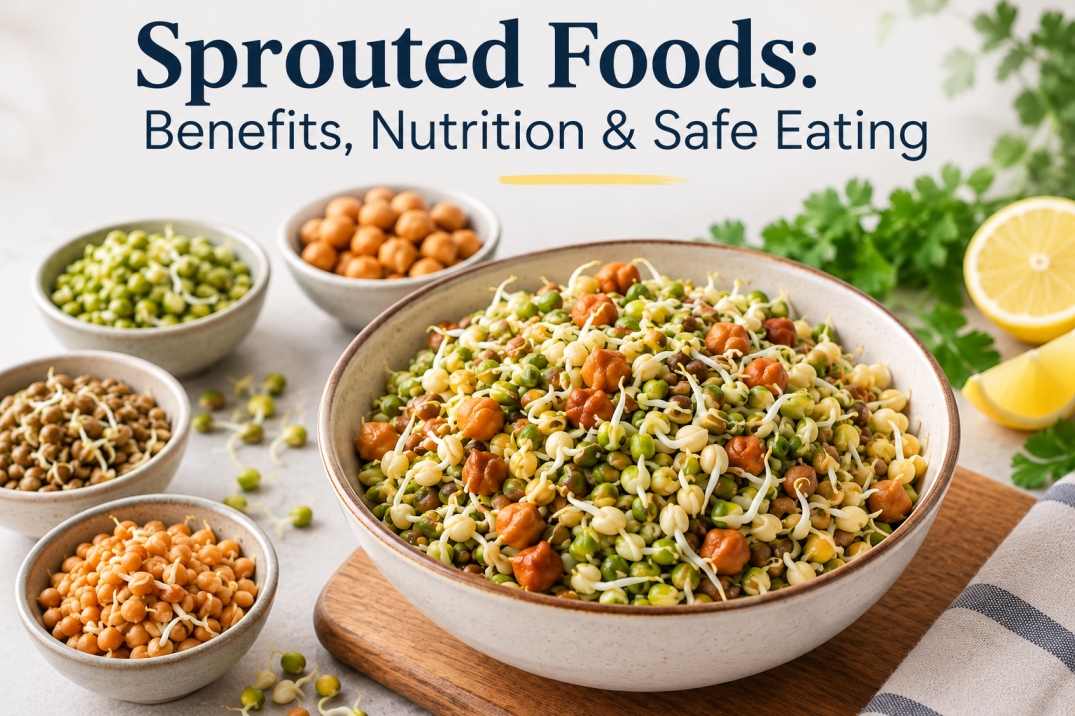
Sprouted Foods: Benefits, Nutrition & Safe Eating
Sprouts have become increasingly popular among people looking for nutritious, protein-rich and minimally processed foods. From moong sprouts and chickpea sprouts to sprouted grains and seeds, they are often promoted as a healthier alternative to their unsprouted forms.
But are sprouted foods actually more nutritious?
The short answer is: sometimes, but not in every way and not for every food.
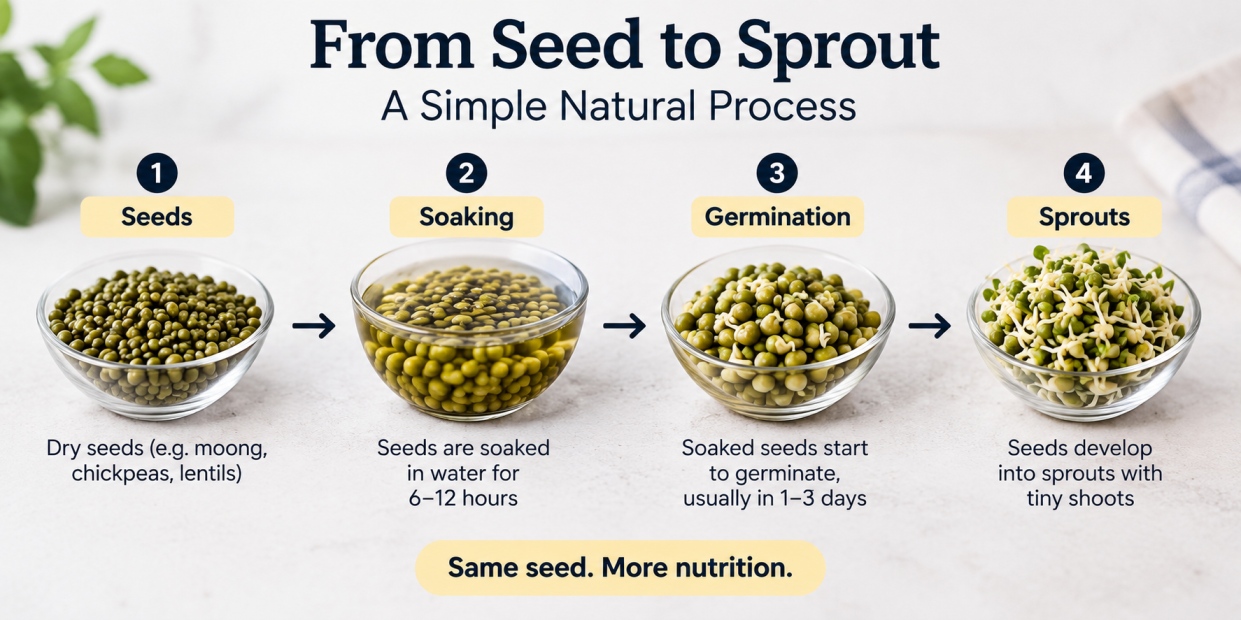
Sprouting is a natural process in which a seed, grain or legume begins to germinate under suitable conditions of moisture, temperature and time. During this process, the plant becomes metabolically active and begins breaking down some of the compounds stored in the seed.
This can change the food's nutritional profile and may improve the availability of certain nutrients. Research suggests that sprouting can reduce phytate and, in some cases, improve the bio accessibility of minerals such as iron and zinc. Protein digestibility may also improve in some grains and legumes, although results vary considerably depending on the food and sprouting conditions.
However, sprouting does not magically transform an ordinary food into a superfood. Overall diet quality, portion size, preparation method and food safety still matter.
In this guide, we will explain what happens during sprouting, whether sprouts are more nutritious, their potential benefits, how they can fit into a weight-loss diet, the difference between raw and cooked sprouts, and how to consume them safely.https://www.fda.gov/food/consumers/people-risk-foodborne-illness
What Are Sprouted Foods?
Sprouted foods are foods produced from seeds, grains, legumes or certain nuts that have been allowed to germinate.
Common examples include:
Green moong sprouts
Black gram sprouts
Chickpea sprouts
Lentil sprouts
Moth bean sprouts
Pea sprouts
Sprouted wheat
Sprouted barley
Sprouted millet
Sprouted brown rice
Sprouted seeds
During germination, the seed absorbs water and activates enzymes that help break down stored carbohydrates, proteins and other compounds so the developing plant can use them.
This process changes the structure and composition of the food.
Sprouting has been used traditionally for centuries, particularly in many Asian food cultures. In Indian diets, sprouted legumes such as moong, matki, chana and moth beans are commonly used in snacks, salads, curries, usal, misal and other dishes.
What Happens to Food During Sprouting?
A seed is essentially a compact package containing nutrients and energy required for a new plant.
When water is absorbed, germination begins.
Several changes can occur:
1. Enzymes Become More Active
Sprouting activates enzymes involved in breaking down stored nutrients.
For example, enzymes begin breaking down complex carbohydrates and proteins into smaller compounds that can be used by the growing plant.
This can alter the texture and digestibility of the food.
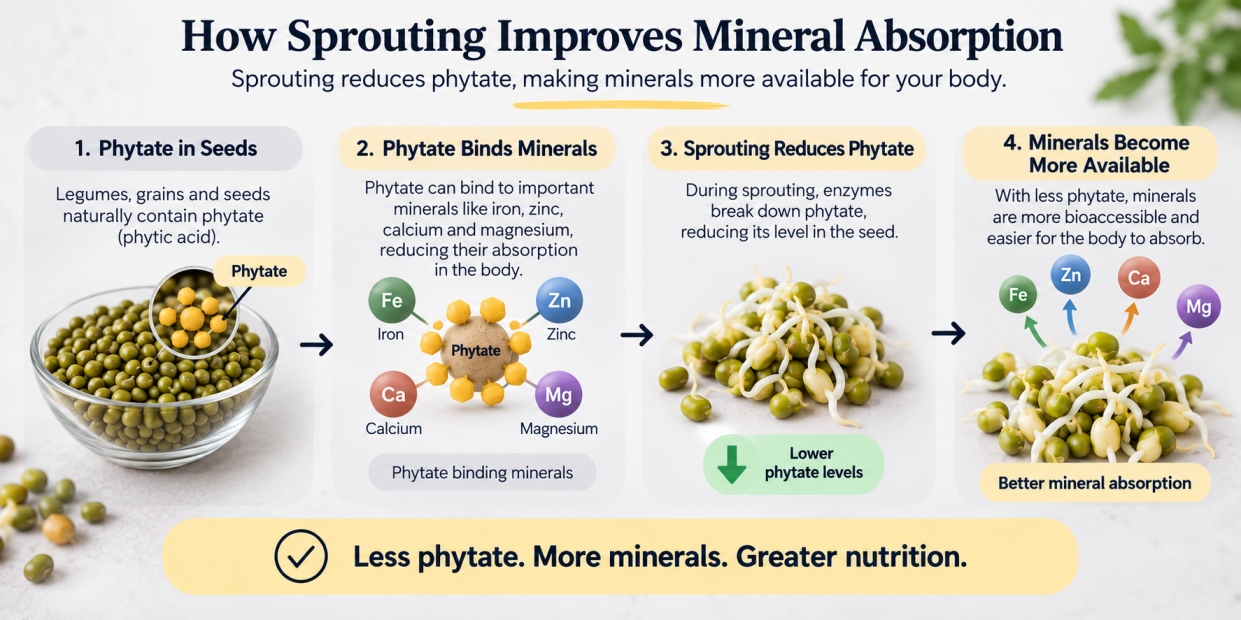
2. Phytate May Decrease
One of the most interesting changes during sprouting is the reduction of phytate, also known as phytic acid.
Phytate naturally occurs in many grains, legumes, nuts and seeds. It can bind minerals such as iron, zinc and calcium, potentially reducing their absorption.
Sprouting activates phytase enzymes that can break down phytate.
Research reviews suggest that sprouting can reduce phytate and may improve mineral bioaccessibility, although the extent of the effect depends on the food, variety, sprouting duration and conditions.
3. Protein Digestibility May Change
Sprouting can partially break down some proteins and may increase protein solubility and digestibility in certain grains and legumes.
However, this effect is not universal.
Some studies have observed improved protein digestibility after sprouting, while others have found little or no improvement depending on the food and processing conditions.
4. Vitamin Levels Can Change
Germination can alter levels of certain vitamins and bioactive compounds.
For example, some studies report increases in certain B vitamins and antioxidant-related compounds during germination.
However, the exact changes depend heavily on:
Type of food
Variety
Sprouting time
Temperature
Light exposure
Storage
Cooking method
Therefore, it is better to think of sprouting as changing the nutritional profile rather than simply making every nutrient higher.
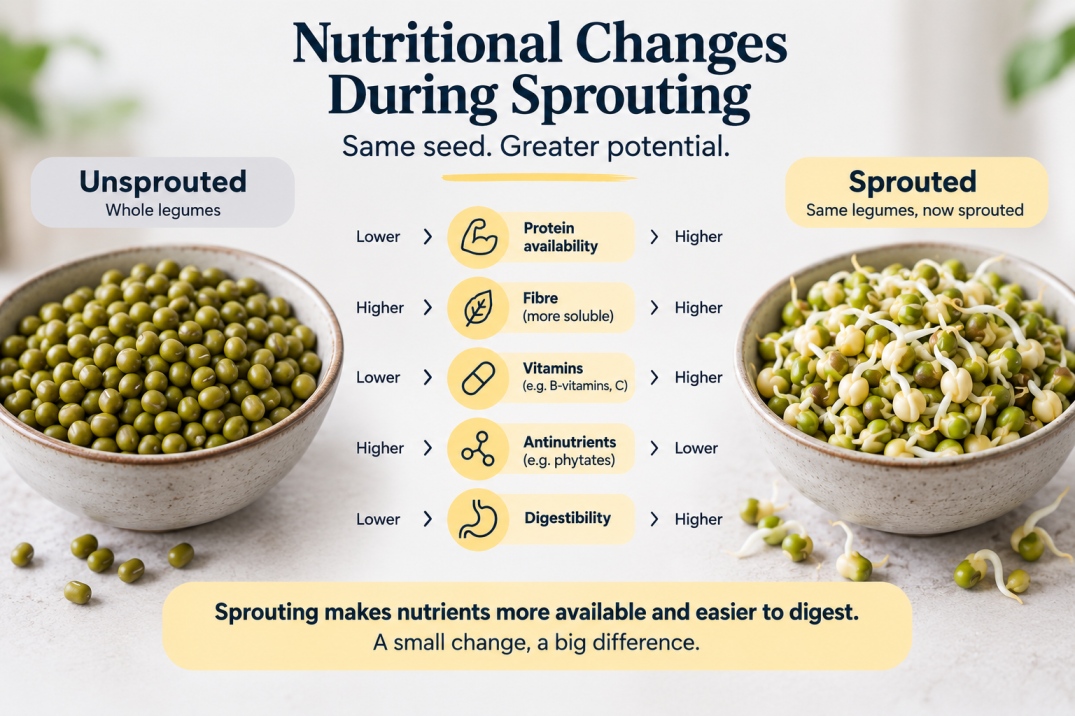
Are Sprouted Foods Really More Nutritious?
This is where the answer becomes more interesting.
Sprouted foods can have nutritional advantages, but "more nutritious" depends on what nutrient you are looking at.
Sprouting may:
Reduce phytate
Improve bioaccessibility of some minerals
Improve digestibility of some proteins
Change antioxidant compounds
Alter carbohydrate structure
Increase certain bioactive compounds
But it does not mean that every sprouted food automatically contains more calories, protein, vitamins or minerals than its original form.
The nutritional advantage may come from better nutrient availability rather than simply a larger amount of nutrients.
For example, if the total iron content remains similar but less phytate is present to bind that iron, the body may potentially have better access to it.
That distinction is important.
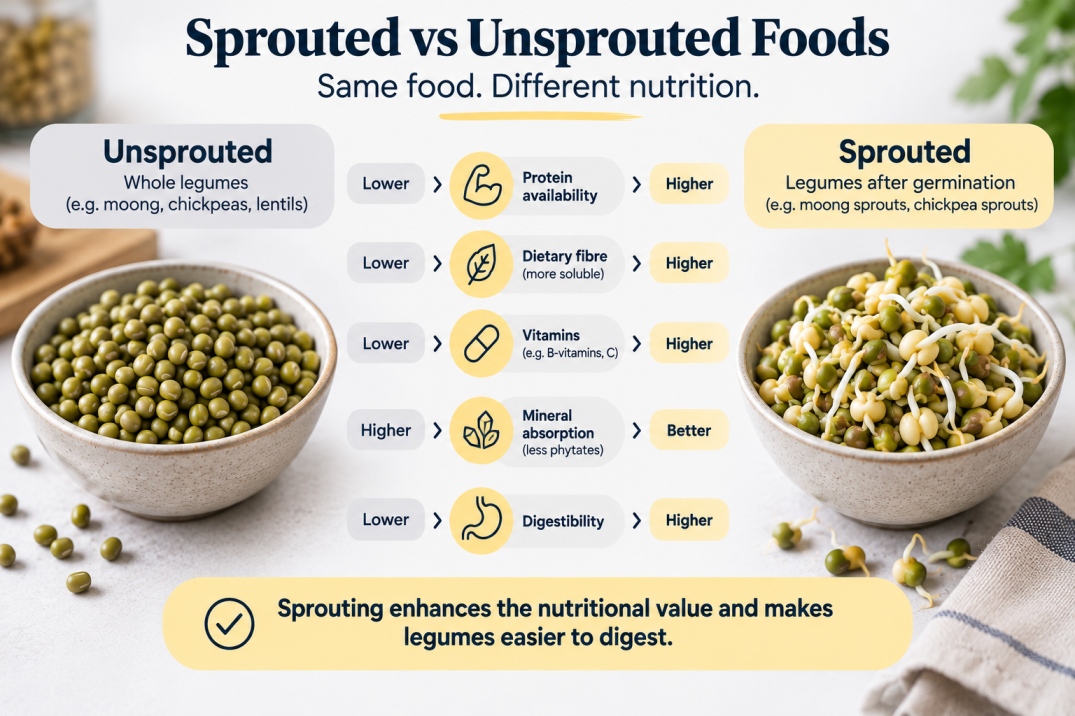
Sprouted vs Unsprouted Foods
Feature
Unsprouted Food
Sprouted Food
Germination
No
Yes
Enzyme activity
Lower
Higher
Phytate
Generally higher
May decrease
Mineral bioaccessibility
Can be limited by phytate
May improve
Protein digestibility
Variable
May improve in some foods
Carbohydrate structure
Original form
Changes during germination
Antioxidant compounds
Food-dependent
May increase in some foods
Digestibility
Depends on food
May improve in some cases
Food safety
Generally easier to manage
Raw sprouts require extra care
The important point is that sprouting is a processing method, not a guarantee of superior nutrition.
Nutritional Benefits of Sprouted Foods
1. May Improve Mineral Absorption
Minerals such as iron and zinc are important for energy production, immunity, oxygen transport and many metabolic functions.
Phytate can bind minerals and reduce their bioavailability.
Because sprouting can reduce phytate, it may improve the bioaccessibility of certain minerals.
Research has reported improved iron, zinc and calcium bioaccessibility in some sprouted cereals and legumes, although results vary by food.
Practical Tip
Pair plant-based iron sources with vitamin C-rich foods such as:
Amla
Guava
Orange
Lemon
Tomatoes
Capsicum
This can further support non-heme iron absorption.
2. May Improve Protein Digestibility
Legumes are valuable sources of plant protein.
Sprouting activates enzymes and changes the structure of the seed, which may improve protein digestibility in some foods.
Sprouted:
Moong
Chickpeas
Lentils
Moth beans
Peas
can therefore be useful additions to a balanced diet.
However, sprouts should not be treated as a complete replacement for all other protein sources.
A healthy diet should include a variety of protein-rich foods such as:
Dal
Beans
Soy
Tofu
Paneer
Curd
Eggs
Fish
Chicken
depending on dietary preferences.https://www.nin.res.in/dietaryguidelines/
3. Can Add Fiber to the Diet
Many sprouted legumes retain their fiber.
Fiber is important for:
Digestive health
Satiety
Blood sugar regulation
Cholesterol management
Healthy bowel function
Weight management
Sprouts can therefore be included as part of a high-fiber eating pattern.
However, the amount of fiber you consume depends on the overall portion and type of sprout.
Sprouts should complement vegetables, fruits, whole grains, nuts, seeds and other legumes rather than replacing them.https://wellorafit.com/services/nutrition-diet-planning/
4. May Support Better Digestion for Some People
Some people find properly prepared sprouts easier to digest than certain unsprouted legumes.
This may be partly related to changes in carbohydrates and proteins during germination.
However, sprouts can still cause:
Gas
Bloating
Abdominal discomfort
in some individuals, particularly when large amounts are eaten suddenly.
If you are not used to legumes, start with a small portion and increase gradually.
Cooking sprouts can also make them easier to tolerate.
5. Provides a Nutrient-Dense Food Option
Sprouted legumes can provide a combination of:
Protein
Fiber
Folate
Iron
Magnesium
Potassium
Other micronutrients
Their nutritional value makes them useful in balanced Indian meals.
Instead of thinking of sprouts as a "special diet food," consider them one of many nutritious whole-food options.https://wellorafit.com/services/nutrition-diet-planning/
6. Can Support Healthy Weight Management
Sprouts can fit well into a weight-management diet because legumes provide protein and fiber, two nutrients that can help support fullness.
For example, a balanced meal could include:
Moong sprouts + vegetables + curd + whole grain
rather than relying on a large bowl of sprouts alone.
The goal is not simply to eat sprouts for weight loss.
Weight management depends on the overall balance between:
Total calorie intake
Protein
Fiber
Food quality
Physical activity
Sleep
Stress
Consistency
Sprouts can support that pattern, but they are not a fat-burning food.
Do Sprouts Help With Blood Sugar?
Sprouted legumes can be part of a balanced diet for people trying to improve overall carbohydrate quality.
Legumes generally provide fiber, protein and complex carbohydrates.
However, the effect of sprouting on blood glucose response is not identical for every food.
Instead of focusing on sprouts alone, build balanced meals containing:
Protein
Vegetables
High-fiber carbohydrates
Healthy fats
Portion size also matters.
For people with diabetes or prediabetes, individual carbohydrate needs should be considered as part of their overall nutrition plan.
Are Sprouts Good for Gut Health?
Sprouts can contribute fiber and plant compounds to the diet, which can support a diverse, fiber-rich eating pattern.
However, sprouts should not be described as a probiotic food.
Probiotics are live microorganisms that provide health benefits when consumed in adequate amounts.
Fresh sprouts are not automatically probiotic simply because they are germinated.
For gut health, focus on dietary variety.
Include:
Vegetables
Fruits
Whole grains
Pulses
Legumes
Nuts
Seeds
Fermented foods such as curd
A diverse diet provides different types of fibers and plant compounds that can support the gut microbiome.
Which Sprouts Are Commonly Used in Indian Diets?
Moong Sprouts
Moong is one of the most commonly sprouted legumes in Indian households.
It can be used in:
Sprout chaat
Usal
Sabzi
Poha
Chilla
Mixed vegetable preparations
Moth Bean Sprouts
Moth beans, or matki, are traditionally sprouted and used in Maharashtrian and western Indian dishes.
They can be added to:
Usal
Misal
Curries
Mixed-legume dishes
Chickpea Sprouts
Chickpeas can be sprouted and added to salads, chaat and cooked preparations.
They provide plant protein and fiber.
Lentil Sprouts
Different lentils can also be germinated and incorporated into meals.
Using different legumes increases dietary variety.
Raw vs Cooked Sprouts: Which Is Better?
This is an important question.
Raw sprouts may retain some heat-sensitive nutrients, but they also have a greater food-safety concern.
Sprouts are grown in warm, moist conditions that can also allow harmful bacteria such as Salmonella, Listeria and E. coli to multiply if contamination is present.
Therefore, cooking sprouts thoroughly is a safer option, particularly for people at higher risk of foodborne illness.
For many people, lightly cooking or thoroughly cooking sprouts can provide a practical balance between nutrition, digestibility and food safety.
Who Should Be Especially Careful With Raw Sprouts?
Certain groups are more vulnerable to serious foodborne illness.
These include:
Pregnant women
Young children
Older adults
People with weakened immune systems
People with certain underlying medical conditions
Food-safety authorities advise higher-risk individuals to avoid raw or lightly cooked sprouts.
For these groups, cooked sprouts are a safer choice.
How to Eat Sprouts Safely
If you prepare sprouts at home, food hygiene is extremely important.
Follow these practices:
Use clean utensils and containers.
Wash your hands before handling the sprouts.
Use good-quality seeds intended for sprouting.
Keep the sprouting container clean.
Avoid leaving sprouts at room temperature for unnecessarily long periods.
Refrigerate sprouts appropriately after preparation.
Avoid consuming sprouts that look slimy, smell unpleasant or appear spoiled.
Cook sprouts thoroughly when food safety is a concern.
Washing alone cannot guarantee that contaminated sprouts are safe because bacteria can be associated with the seed and may multiply during sprouting.
Can You Eat Sprouts Every Day?
For most healthy people, sprouts can be included regularly as part of a varied diet.
However, there is no requirement to eat sprouts every day.
Nutrition is about dietary variety rather than relying on one "superfood."
You can rotate between:
Dal
Whole legumes
Sprouts
Paneer
Tofu
Curd
Eggs
Fish
Chicken
Nuts
Seeds
depending on your dietary pattern.
How Much Sprouts Should You Eat?
There is no universal "ideal" serving of sprouts.
A practical portion for many adults can be around:
½–1 cup cooked sprouts as part of a balanced meal.
The appropriate amount depends on:
Overall calorie requirements
Protein needs
Digestive tolerance
Physical activity
Other foods eaten in the meal
For weight loss, remember that adding a large amount of sprouts on top of an already calorie-dense meal does not automatically make the meal healthier.
Best Ways to Include Sprouts in Indian Meals
Sprouts do not have to mean a plain raw salad.
Try:
Breakfast
Moong Sprout Chilla
Combine sprouted moong with vegetables and spices and cook as a chilla.
Mid-Morning
Cooked Sprout Chaat
Combine cooked sprouts with:
Tomato
Cucumber
Coriander
Lemon
Roasted cumin
Lunch
Sprouted Moong Usal + Roti + Vegetable
This creates a more complete meal instead of eating sprouts alone.
Snack
Warm Sprout Bowl
Combine cooked sprouts with sautéed vegetables and spices.
Dinner
Sprouted Moong Khichdi
Combine sprouts with a suitable grain and vegetables for a balanced one-pot meal.
Sprouts for Weight Loss: What You Need to Know
Sprouts can be a useful weight-loss food because they can contribute protein and fiber to meals.
But eating sprouts alone will not cause fat loss.
A sustainable weight-loss meal should generally combine:
Protein + Fiber + Vegetables + Appropriate Carbohydrate + Controlled Fat
For example:
1 bowl cooked moong sprouts + 1–2 small rotis + 1 bowl vegetable sabzi + curd
can be more balanced than a large bowl of sprouts eaten alone.
Portion control remains important because even nutritious foods contribute calories.
Common Myths About Sprouted Foods
Myth 1: Sprouted Foods Are Always More Nutritious
Fact: Sprouting can improve the availability of certain nutrients and reduce phytate, but nutritional changes vary by food and sprouting conditions.
Myth 2: Sprouts Are a Complete Protein
Fact: Legume sprouts provide useful plant protein, but protein quality and amino-acid composition vary. A varied diet containing different protein sources is a better approach.
Myth 3: Raw Sprouts Are Always Healthier
Fact: Raw sprouts may retain some heat-sensitive nutrients, but raw sprouts carry a higher food-safety risk because of the conditions used for sprouting.
Myth 4: Sprouts Burn Belly Fat
Fact: No single food selectively burns belly fat.
Sprouts can support a nutritious, high-fiber eating pattern, but reducing body fat requires an overall sustainable approach involving nutrition, physical activity and energy balance.
Myth 5: You Need Sprouts Every Day
Fact: Sprouts can be nutritious, but they are not essential every day. A diverse diet is more important than relying on one food.
Sprouted Foods vs Supplements
One reason sprouts are popular is that they are a whole-food option.
Instead of immediately turning to powders, pills or supplements, many people can improve their nutritional intake by increasing the variety of whole foods in their diet.
Sprouts can provide:
Protein
Fiber
Micronutrients
Plant compounds
But they should complement—not replace—a balanced diet.
If a person has a diagnosed nutrient deficiency, food alone may not always be sufficient and professional advice may be needed.
How to Make Sprouts Part of a Balanced Plate
A simple approach is to use sprouts as the protein/fiber component of a meal.
For example:
Balanced Indian Plate
¼ plate: Sprouted legumes or another protein source
¼ plate: Roti, brown rice, millet or another whole-grain carbohydrate
½ plate: Non-starchy vegetables
Add:
Curd or buttermilk if suitable
Small amount of healthy fat
Whole fruit as needed
This approach is more useful for long-term health than simply asking whether sprouts are "better" than unsprouted foods.
What Does the Science Actually Say?
The scientific evidence gives a nuanced answer.
Research reviews indicate that sprouting can activate phytase and reduce phytate, potentially improving the bioaccessibility of minerals such as iron and zinc. Protein digestibility may also improve in some foods. However, the magnitude of these effects varies significantly among cereals and legumes, and researchers cannot reliably predict the nutritional effect for every sprouted food.
Therefore:
Sprouting can be nutritionally beneficial, but it is not a universal nutrition upgrade.
The biggest advantage may be that sprouting changes the food in ways that can make certain nutrients more accessible.
Key Takeaways
Sprouted foods are seeds, grains or legumes that have begun to germinate.
Sprouting activates enzymes and changes the food's nutritional composition.
Sprouting can reduce phytate in many cereals and legumes.
Lower phytate may improve the bioaccessibility of minerals such as iron and zinc.
Protein digestibility may improve in some foods, but the effect is not universal.
Sprouts can contribute protein and fiber to a balanced diet.
Sprouts can support healthy weight management when included in an overall calorie-appropriate diet.
Sprouts are not a magic food for weight loss, belly-fat reduction or detoxification.
Raw sprouts carry a food-safety risk because the warm, moist conditions used for sprouting can support bacterial growth.
People at higher risk of foodborne illness should avoid raw or lightly cooked sprouts.
Thoroughly cooking sprouts is a safer option.
The best diet includes a variety of whole foods rather than depending on one "superfood."
Sprouts can be easily incorporated into balanced Indian meals such as usal, chilla, chaat, khichdi and vegetable preparations.
Conclusion
So, are sprouted foods really more nutritious?
The answer is yes in some respects, but not automatically in every respect.
Sprouting is a natural process that changes the nutritional and structural properties of grains and legumes. It can reduce phytate and may improve the bioaccessibility of certain minerals. In some foods, it may also improve protein digestibility and alter beneficial plant compounds.
But nutrition is rarely about finding one "superfood."
For better health and sustainable weight management, sprouts work best as part of a varied diet containing vegetables, fruits, whole grains, pulses, protein-rich foods, healthy fats and adequate hydration.
And when it comes to sprouts, food safety matters just as much as nutrition.
Instead of asking, "Are sprouts better?"
A better question is:
"How can I include sprouts safely and appropriately as part of a balanced diet?"
That is where sprouts can genuinely add value to a healthy lifestyle.
FAQ
1. Are sprouted foods healthier than regular foods?
Sprouting can improve the bioaccessibility of some nutrients and reduce phytate, but it does not make every sprouted food universally more nutritious than its unsprouted form.
2. Do sprouts have more protein?
Sprouting can change protein composition and digestibility, but it does not necessarily mean that every sprouted food has substantially more total protein.
3. Are sprouts good for weight loss?
Yes, sprouts can be included in a weight-loss diet because they can provide protein and fiber. However, weight loss depends on overall calorie balance, diet quality and lifestyle rather than one food.
4. Can sprouts help with iron absorption?
Sprouting can reduce phytate, which may improve the bioaccessibility of minerals such as iron. Pairing plant-based iron sources with vitamin C-rich foods can also support iron absorption.
5. Is it safe to eat raw sprouts?
Raw sprouts can carry harmful bacteria, including Salmonella, Listeria and E. coli. Food-safety authorities recommend particular caution and advise higher-risk individuals to avoid raw sprouts.
6. Are cooked sprouts still nutritious?
Yes. Cooking can change some heat-sensitive nutrients, but cooked sprouts can remain a nutritious source of protein, fiber and other nutrients. Cooking also reduces the food-safety risk associated with raw sprouts.
7. Which sprouts are best?
There is no single "best" sprout. Moong, moth beans, chickpeas and other legumes can all be included depending on dietary preferences and tolerance.
8. Can I eat sprouts every day?
Healthy adults can generally include sprouts regularly if they tolerate them well, but eating them every day is not necessary. Variety is more important.
9. Do sprouts improve digestion?
Sprouting may make some legumes easier to digest, but individual tolerance varies. Some people may still experience gas or bloating.
10. Do sprouts burn belly fat?
No. Sprouts do not selectively burn belly fat. They can support a nutritious eating pattern, but overall fat loss requires a sustainable approach to nutrition, activity and energy balance.
Ready to Begin Your Health Journey?
Get a personalized, medically guided plan built around your unique biology.