Mobility Training for good Health: Benefits & Exercises
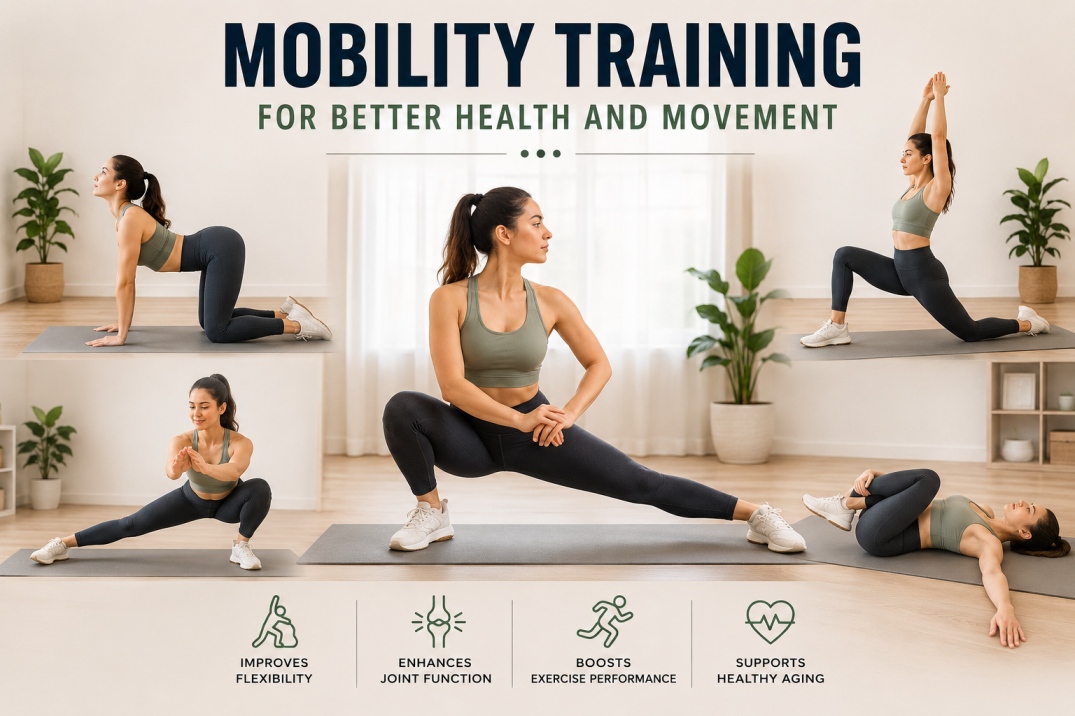
Being fit is not only about strength, endurance, or how much weight you can lift. How well you can move your body also matters.
Mobility training focuses on helping you move your joints through an appropriate range of motion with control and stability.
It can be useful for people of different ages and fitness levels—from beginners who want to move more comfortably to athletes looking to improve movement quality.
Mobility is also different from simply being flexible. Flexibility generally refers to the ability of muscles and other tissues to lengthen, while mobility involves the ability to actively control movement through a range of motion.https://www.who.int
A balanced fitness routine can therefore include:
Mobility + Strength + Cardiovascular Fitness + Recovery
What Is Mobility Training?
Mobility training consists of exercises and movements designed to help you move your joints effectively through their available range of motion.
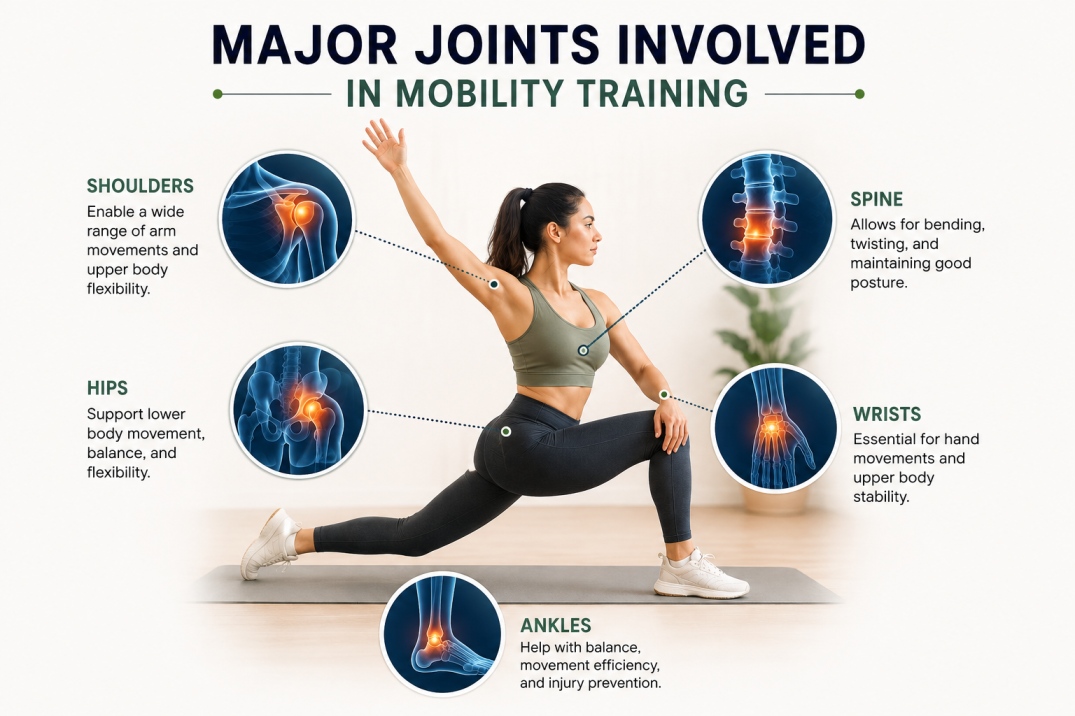
It can involve movements for areas such as:
· Shoulders
· Hips
· Ankles
· Spine
· Wrists
· Knees
Examples include:
· Hip rotations
· Shoulder circles
· Ankle mobility drills
· Thoracic spine rotations
· Controlled leg movements
· Dynamic stretching
· Squat mobility exercises
The goal is not simply to move as far as possible.
The goal is to develop comfortable, controlled movement.
Mobility vs. Flexibility: What's the Difference?
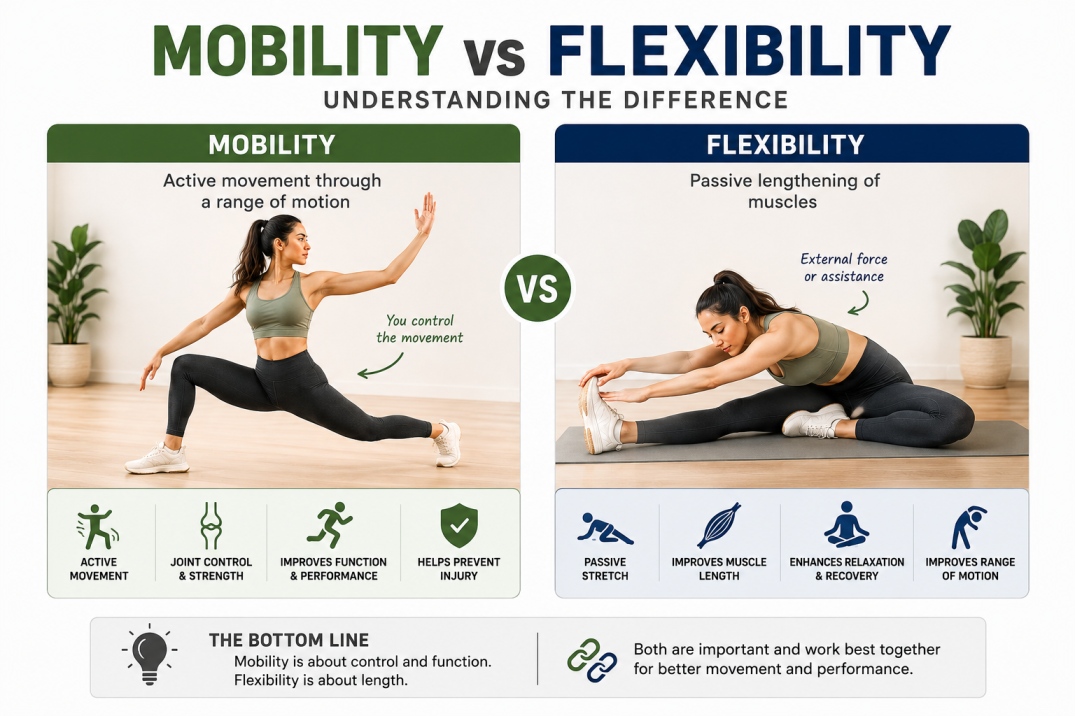
These terms are often used interchangeably, but they are not exactly the same.
Flexibility
Flexibility generally refers to how much a muscle or joint can be passively moved or stretched.
For example:
Being able to reach toward your toes during a stretch demonstrates a certain degree of flexibility.
Mobility
Mobility involves actively controlling movement through a range of motion.
For example:
Being able to move your hip into a deep squat position while maintaining control and stability involves mobility.
In simple terms:
Flexibility = Range available
Mobility = Ability to control that range
Both can contribute to good movement, but mobility involves more than flexibility alone.https://www.cdc.gov
Why Is Mobility Important?
Good mobility can make everyday movements easier and more comfortable.
Think about activities such as:
· Getting up from a chair
· Squatting down
· Reaching overhead
· Bending down
· Walking
· Climbing stairs
· Getting in and out of a car
· Carrying objects
These movements require different joints to work together.
Maintaining mobility can help you perform these activities more efficiently and confidently.
Mobility and Everyday Movement
You don't need to be an athlete to benefit from mobility training.
Everyday movements require joint mobility.
For example:
Picking something up from the floor
requires movement at the hips, knees, ankles, and spine.
Reaching for something on a high shelf
requires shoulder and upper-back mobility.
Walking comfortably
requires coordinated movement through the hips, knees, and ankles.
Mobility training can therefore have practical value beyond the gym.
Mobility and Exercise Performance
Mobility can also influence how comfortably you perform certain exercises.
For example, exercises such as:
· Squats
· Lunges
· Overhead presses
· Deadlifts
· Rows
· Push-ups
require different levels of joint movement and control.
Adequate mobility can help you perform exercises through an appropriate range of motion while maintaining good technique.
However, mobility is only one part of exercise technique.
Strength, stability, coordination, experience, and appropriate exercise selection are also important.https://wellorafit.com/services/fitness-training/
Mobility and Strength Training
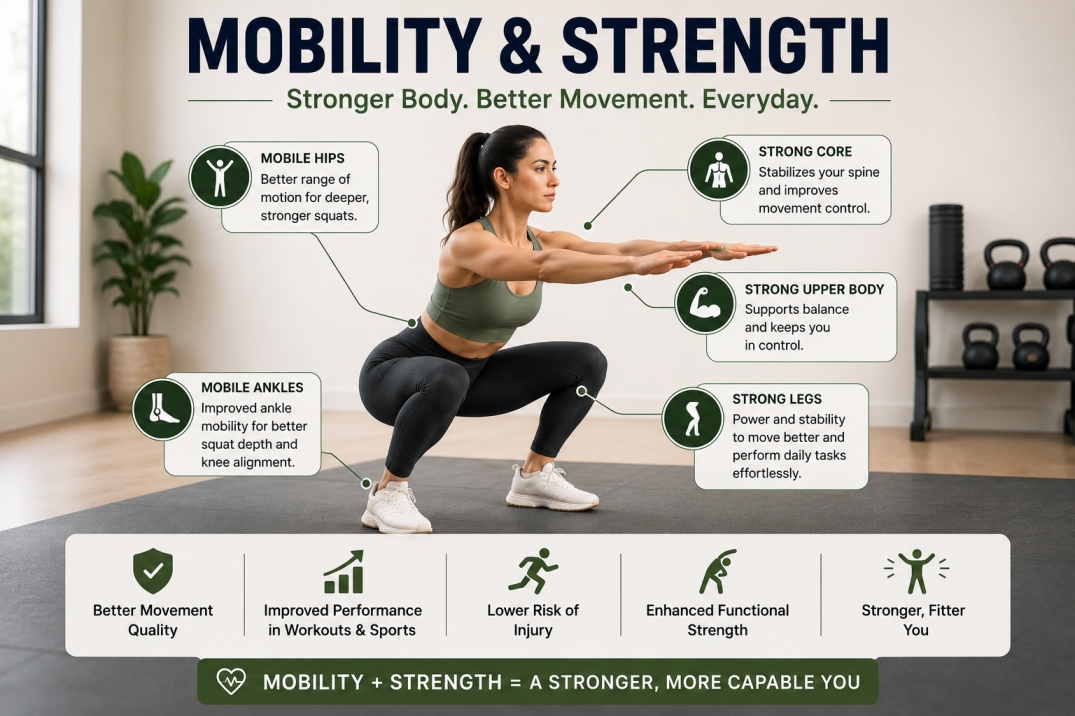
Mobility and strength are not competing concepts.
In fact, they can complement each other.
For example:
Mobility → Allows appropriate movement
Strength → Helps control that movement
This is particularly important when performing exercises that require movement through larger ranges of motion.
A well-rounded program can therefore include both mobility work and resistance training.https://wellorafit.com/services/fitness-training/
Mobility and Healthy Aging
Maintaining the ability to move comfortably becomes increasingly valuable as we age.
Everyday activities such as:
· Walking
· Climbing stairs
· Getting up from the floor
· Reaching
· Bending
· Carrying groceries
require coordinated movement.
Regular physical activity that includes strength, balance, flexibility, and mobility can help support physical function as people get older.
Mobility training can therefore be one useful component of a broader healthy-aging fitness routine.
Does Mobility Training Prevent Injuries?
Mobility training should not be presented as a guarantee against injury.
Injury risk is influenced by many factors, including:
· Training load
· Exercise technique
· Previous injuries
· Strength
· Recovery
· Sleep
· Physical activity level
· Individual health
Mobility work may help improve movement quality for some people, but it is only one part of a complete approach to safe exercise.
Mobility and Posture
Mobility is sometimes promoted as a solution for all posture problems, but posture is more complex than simply having “tight” muscles.
Your posture can be influenced by:
· Muscular strength
· Joint mobility
· Habitual positions
· Work environment
· Pain
· Fatigue
· Individual anatomy
Rather than trying to maintain one perfect posture all day, it is often more useful to change positions regularly and maintain the ability to move comfortably.
Mobility for People Who Sit Frequently
Long periods of sitting can mean that certain joints move through limited ranges during the day.
If you spend many hours at a desk, you can incorporate short movement breaks.
For example:
Work → Stand → Move → Return to work
Simple movements can include:
· Shoulder circles
· Gentle spinal rotations
· Hip movements
· Ankle circles
· Short walks
These don't need to be long workouts.
The goal is simply to introduce more movement into your day.
Mobility Is Not Only Stretching
Traditional stretching can be useful, but mobility training can involve much more.
Mobility exercises may combine:
Movement + Strength + Control + Range of Motion
For example, rather than simply holding a hip stretch, you may perform controlled hip rotations or active movements through a comfortable range.
This makes mobility training different from a stretching routine alone.
How Often Should You Do Mobility Training?
There is no single schedule that works for everyone.
Mobility work can be included:
· Before workouts
· After workouts
· During recovery days
· During work breaks
· As a short morning routine
· As part of a longer fitness session
Even a few minutes of regular movement can be easier to maintain than an occasional long mobility session.
Consistency matters more than making every session lengthy.
Who Can Benefit From Mobility Training?
Mobility training can be useful for:
· Beginners
· Desk workers
· Older adults
· Strength-training enthusiasts
· Runners
· Recreational athletes
· People who feel stiff from inactivity
· People who want to maintain comfortable movement
The exercises should be appropriate for the individual's fitness level and physical condition.
Benefits of Mobility Training for Better Health
Mobility training is not only useful for improving exercise technique. Regular mobility work can support movement quality, physical function, exercise readiness, and healthy aging.
The benefits depend on the type of mobility exercises performed, the individual's current mobility, and how consistently they train.
1. Improves Range of Motion
Mobility exercises can help you work on the range of motion available at different joints.
For example:
· Shoulder mobility can support overhead movements.
· Hip mobility can support squatting and lunging.
· Ankle mobility can contribute to comfortable walking and lower-body movements.
· Thoracic spine mobility can support upper-body rotation and reaching.
The goal is not to force joints into extreme positions.
Instead, focus on gradually developing comfortable and controlled movement.
2. Supports Better Movement Quality
Good movement requires more than strength.
Your body needs to coordinate:
Mobility + Stability + Strength + Control
For example, a squat requires appropriate movement at the ankles, knees, hips, and spine while the muscles control the position.
Mobility training can help you practice these movements in a controlled way.
3. Helps With Everyday Activities
Mobility isn't only about improving gym performance.
It can make everyday movements easier to practice, such as:
· Bending down
· Reaching overhead
· Getting out of a chair
· Climbing stairs
· Walking
· Getting in and out of a car
· Picking objects up from the floor
Maintaining these movement abilities can become increasingly important with age.
4. Supports Exercise Technique
Some exercises require adequate movement at specific joints.
For example:
Squats
Require coordinated movement through the hips, knees, and ankles.
Overhead Presses
Require adequate shoulder and upper-back movement.
Lunges
Require movement and control through the hips, knees, and ankles.
Deadlifts
Require appropriate hip movement and control.
Mobility work can complement exercise technique, but it should not be used to compensate for poor programming or inappropriate exercise selection.https://wellorafit.com/services/fitness-training/
5. Can Help You Feel Less Stiff
People who spend long periods sitting may sometimes feel stiff, particularly around areas such as the:
· Hips
· Upper back
· Shoulders
· Ankles
Gentle movement throughout the day can help you avoid staying in one position for too long.
Try:
Sit → Move → Stretch gently → Walk → Return to work
You don't need to wait until you feel extremely stiff before moving.
6. Supports Healthy Aging
Maintaining physical function is an important part of healthy aging.
As people get older, maintaining the ability to:
· Walk comfortably
· Get up from a chair
· Reach
· Bend
· Turn
· Climb stairs
can help support independence in daily life.
Mobility training can be combined with strength, balance, aerobic activity, and other forms of physical activity to create a more complete approach to healthy aging.
7. Complements Strength Training
Strength and mobility work well together.
Strength training helps you produce and control force.
Mobility training helps you work on movement through an appropriate range of motion.
For example:
Mobility → Move into position
Strength → Control and produce force
Stability → Maintain control
This combination can help create a more balanced fitness routine.
8. Can Support Warm-Up Routines
Dynamic mobility movements can be included in a warm-up before exercise.
For example:
· Arm circles
· Hip rotations
· Ankle movements
· Bodyweight squats
· Walking lunges
· Controlled leg swings
A warm-up should prepare you for the activity you're about to perform.
The exercises should be appropriate to the workout rather than being a random collection of stretches.
9. Useful During Recovery Days
Mobility work can also fit into a recovery day.
Gentle movements may provide an opportunity to stay active without performing another demanding workout.
A recovery session might include:
· Gentle walking
· Light mobility exercises
· Controlled joint movements
· Easy stretching
The intensity should remain low enough that you don't feel like you're completing another hard training session.
10. Supports Active Lifestyle Habits
Mobility training can encourage people to think about movement beyond formal workouts.
Instead of exercising for one hour and remaining inactive for the rest of the day, aim for regular movement throughout your routine.
For example:
Morning → Short mobility routine
Workday → Movement breaks
Evening → Walk or exercise
This creates a more active daily lifestyle.
11. May Help Maintain Functional Movement
Functional movement refers to movements that are useful in everyday life.
Examples include:
· Squatting
· Reaching
· Bending
· Rotating
· Walking
· Stepping
· Getting up and down
Mobility exercises can be selected around these movement patterns rather than focusing only on isolated stretches.
12. Mobility Can Be Adapted to Different Fitness Levels
Mobility training doesn't have to be difficult.
Beginner
Start with:
· Gentle joint circles
· Easy walking
· Controlled bodyweight movements
· Simple stretching
Intermediate
Add:
· Dynamic mobility drills
· Controlled range-of-motion exercises
· Mobility-focused warm-ups
Advanced
You may incorporate:
· Loaded mobility exercises
· More challenging movement patterns
· Sport-specific mobility work
The level should match your ability and training goals.
13. Mobility and Flexibility Can Work Together
Mobility and flexibility are not competing concepts.
If limited flexibility is restricting your movement, flexibility work may be useful.
If you have sufficient range but struggle to control it, mobility and strength work may be more relevant.
A complete movement routine can therefore include:
Flexibility + Mobility + Strength + Stability
The emphasis should depend on the individual's needs.
14. Mobility Is Not a Quick Fix
Mobility usually improves through consistent practice, not one intense session.
Trying to force a joint into a position it cannot comfortably reach is unlikely to be a good strategy.
Instead:
Start comfortably → Practice regularly → Progress gradually
This approach is more sustainable.
Practical Mobility Exercises & How to Add Them to Your Routine
Mobility training does not have to be complicated or time-consuming. A few well-chosen movements can be included in your warm-up, workout, recovery routine, or daily movement breaks.
The key is to move slowly, stay controlled, and work within a comfortable range.
1. Neck Mobility
Gentle neck movements can help you regularly move the cervical spine through comfortable positions.
Try:
· Slowly turning your head left and right
· Gentle side-to-side movements
· Controlled chin movements
Avoid forcing the neck into extreme positions or moving through pain.
2. Shoulder Circles
Shoulder circles are a simple movement for the shoulder area.
How to do it
1. Stand comfortably.
2. Slowly circle your shoulders backward.
3. Repeat in a controlled manner.
4. Reverse the direction.
Keep the movement comfortable rather than trying to make the largest possible circle.
3. Arm Circles
Arm circles can be used as part of a warm-up or short mobility break.
Move your arms slowly through a comfortable range.
You can gradually make the circles larger if the movement remains comfortable and controlled.
4. Thoracic Spine Rotations
The upper back plays an important role in movements involving reaching and rotation.
A simple thoracic rotation can be performed from a comfortable seated or quadruped position.
Focus on:
· Controlled rotation
· Comfortable range
· Keeping the movement smooth
· Avoiding forceful twisting
This can be particularly useful as a movement break for people who spend long periods sitting.
5. Cat-Cow Movement
The cat-cow movement gently takes the spine through different positions.
Basic movement
Start on your hands and knees.
Slowly:
Round your back → Return through neutral → Gently extend your spine
Move with your breathing and avoid forcing the range.
This can be a simple addition to a warm-up or mobility session.
6. Hip Circles
The hips are involved in walking, squatting, climbing stairs, and many other everyday movements.
Controlled hip circles can help you practice moving the hip joint through different directions.
Stand while holding onto a stable surface if needed and make small, controlled circles with one leg.
Repeat on the other side.
7. 90/90 Hip Mobility
The 90/90 position can be used to explore hip rotation.
Sit with your legs positioned comfortably in a 90/90-style position.
From there, practice controlled movement between the positions rather than forcing your hips into a deep stretch.
If this position is uncomfortable, use a simpler hip mobility exercise.
8. Ankle Mobility
Ankle movement is important for activities such as walking, squatting, lunging, and climbing stairs.
Simple ankle drill
Stand facing a wall or stable surface.
Place one foot slightly forward and gently move the knee toward the wall while keeping the heel down.
Move only within a comfortable range.
Repeat on both sides.
9. Deep Squat Hold — Modified if Needed
A supported squat position can be used to work on mobility through the hips, knees, and ankles.
If a deep squat is difficult, use:
· A chair
· A stable support
· A higher squat position
The goal is controlled movement, not achieving the deepest possible squat.
10. World's Greatest Stretch — Modified
This commonly used mobility sequence combines several movements involving the hips, spine, and upper body.
However, the full version may be challenging for beginners.
Start with a simpler version and focus on:
· Comfortable range
· Controlled movement
· Stable positioning
· Smooth breathing
Mobility exercises should be adapted to your current ability.
11. Controlled Leg Swings
Leg swings can be included in a dynamic warm-up.
Hold onto a stable surface and gently swing one leg forward and backward.
Keep the movement controlled rather than aggressively swinging the leg.
You can also perform gentle side-to-side movements when appropriate.
12. Wrist Mobility
Wrist mobility can be useful for people who type frequently or perform exercises that place the hands and wrists under load.
Try:
· Gentle wrist circles
· Flexion and extension movements
· Controlled rotations
Avoid aggressive stretching or movements that cause pain.
13. A Simple 10-Minute Mobility Routine
You don't need an hour-long session.
A simple routine could include:
1–2 Minutes
Shoulder circles + arm movements
1–2 Minutes
Thoracic rotations
2 Minutes
Hip mobility
2 Minutes
Ankle mobility
1–2 Minutes
Controlled squats or supported squats
1–2 Minutes
Gentle full-body movement
Adjust the exercises and duration according to your fitness level.
14. Mobility Before a Workout
Before exercise, mobility work can be incorporated into a dynamic warm-up.
For example:
Strength Workout
→ Shoulder circles
→ Thoracic rotations
→ Hip mobility
→ Bodyweight squats
→ Workout
The warm-up should gradually prepare your body for the movements you are about to perform.
15. Mobility After a Workout
After exercise, you may choose gentle mobility or stretching as part of your cooldown.
Keep the intensity comfortable.
The purpose is to gradually transition from exercise to normal activity rather than forcing flexibility gains immediately after training.
16. Mobility on Recovery Days
Mobility work can also be included on recovery days.
A recovery session might look like:
10–15 minutes gentle mobility + easy walking
Keep the intensity low.
If the session makes you feel more fatigued rather than refreshed, reduce the volume or choose complete rest.
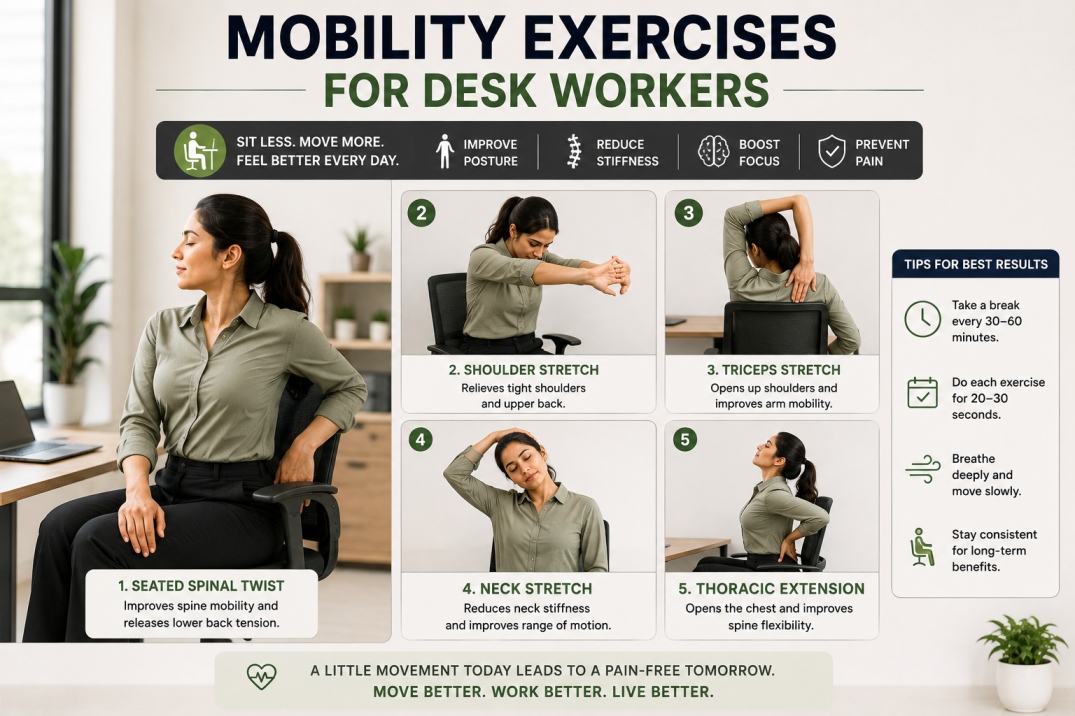
17. Mobility for Desk Workers
If you spend most of your day sitting, try short movement breaks rather than waiting until the end of the day.
For example:
Every 45–60 minutes
· Stand up
· Walk briefly
· Move your shoulders
· Rotate your upper back
· Move your ankles
· Return to work
These short breaks can be easier to maintain than one long mobility session.
18. How to Progress Mobility Training
Progress does not mean forcing yourself into extreme positions.
Instead, you can gradually improve by:
· Increasing control
· Moving more comfortably
· Increasing range gradually
· Improving consistency
· Adding appropriate resistance
· Performing movements more smoothly
Mobility should progress according to your ability.
19. What Not to Do
Avoid:
· Bouncing aggressively during stretches
· Forcing painful ranges
· Comparing your mobility with someone else's
· Trying advanced movements immediately
· Holding your breath
· Treating pain as a sign that the exercise is working
A good mobility session should generally feel controlled and manageable, not painful.
When to Seek Professional Guidance
If you have an existing injury, persistent joint pain, significant stiffness, swelling, numbness, or reduced movement that affects daily activities, consult an appropriate healthcare professional.
A physiotherapist or qualified exercise professional can help identify suitable movements and
Mobility Training for Long-Term Health & Healthy Aging
Mobility training is most valuable when it becomes part of your regular lifestyle rather than something you do only when you feel stiff.
The goal is to maintain the ability to move comfortably, control your body, perform everyday activities, and stay physically active throughout life.
1. Mobility Supports Independence
As we age, maintaining physical function becomes increasingly important.
Everyday activities such as:
· Getting out of a chair
· Climbing stairs
· Bending down
· Reaching overhead
· Walking
· Turning around
· Getting in and out of a vehicle
· Picking things up from the floor
all require coordinated movement.
Maintaining mobility alongside strength and balance can help support independence and physical function.
2. Combine Mobility With Strength
Mobility alone is not enough for complete physical fitness.
A well-rounded routine should include:
Mobility → Move through a useful range
Strength → Control and produce force
Balance → Maintain stability
Cardiovascular Exercise → Build endurance
Together, these components support a more complete approach to physical health.
3. Mobility and Healthy Aging
Healthy aging is not simply about preventing disease. It is also about maintaining the ability to participate in everyday life.
Regular physical activity that includes strength, balance, flexibility, and movement can support physical function as you age.
Mobility exercises can be one component of this broader approach.
The goal is not to become extremely flexible.
The goal is to keep moving well for as long as possible.
4. Mobility Can Support an Active Lifestyle
Good movement capacity can make it easier to participate in activities you enjoy.
For example:
· Walking
· Hiking
· Cycling
· Dancing
· Swimming
· Recreational sports
· Strength training
· Yoga
Mobility should therefore be viewed as a tool that supports an active lifestyle rather than an isolated fitness goal.
5. Make Mobility a Daily Habit
You don't need a separate one-hour mobility workout.
Instead, add small amounts of movement throughout your day.
Morning
5–10 minutes of gentle mobility.
During Work
Short movement breaks every so often.
Before Exercise
Dynamic movements relevant to your workout.
After Exercise
Gentle mobility or stretching if comfortable.
Recovery Days
Light mobility combined with easy movement.
This makes mobility easier to maintain consistently.
6. Build a Routine Around Your Needs
Not everyone needs the same mobility exercises.
A desk worker may want to focus more on:
· Upper back
· Shoulders
· Hips
· Ankles
A runner may have different movement priorities.
Someone doing strength training may need mobility work that complements their specific exercises.
Your routine should therefore be based on your movement needs, rather than copying someone else's routine from social media.
7. Don't Chase Extreme Flexibility
Being able to perform an impressive stretch does not automatically mean you have excellent mobility.
Mobility is about usable, controlled movement.
Instead of asking:
“How far can I stretch?”
Ask:
“Can I control this movement comfortably?”
This shift in focus can make mobility training more practical.
8. Consistency Matters More Than Duration
A short routine performed regularly can be easier to maintain than an occasional long session.
For example:
10 minutes × several days a week
may be more practical than:
60 minutes once every few weeks
You don't have to spend a lot of time on mobility for it to become part of your lifestyle.
9. Mobility and Weight Management
Mobility training itself is not a major calorie-burning strategy.
Its value comes from helping you maintain the ability to move and participate in physical activity.
A healthy weight-management routine can combine:
Balanced Nutrition + Strength Training + Cardio + Daily Movement + Mobility + Recovery
Each component has a different role.
10. Mobility and Recovery
Mobility can fit naturally into recovery days.
Gentle movement may help you stay active without adding another demanding workout.
For example:
Easy walk → Gentle hip mobility → Shoulder movements → Light stretching
Keep the session comfortable and low intensity.
If you are experiencing significant pain or unusual fatigue, rest may be more appropriate.
11. Don't Ignore Persistent Pain
Mobility exercises should not be used to push through persistent pain.
Seek professional evaluation if you experience:
· Persistent joint pain
· Swelling
· Numbness
· Significant weakness
· Loss of movement
· Pain that affects everyday activities
· Symptoms that worsen with exercise
A physiotherapist or other qualified healthcare professional can help determine the appropriate approach.
Common Mobility Mistakes
1. Moving Too Quickly
Mobility exercises are generally more useful when performed with control.
2. Forcing the Range
More range is not automatically better.
3. Ignoring Strength
Mobility and strength work together.
4. Doing Mobility Only Once a Month
Consistency matters.
5. Copying Advanced Exercises
Exercises should match your current ability.
6. Treating Pain as Normal
Discomfort from effort can be different from pain caused by an injury or underlying problem.
7. Focusing Only on Flexibility
Mobility involves control, stability, and usable range—not flexibility alone.
A Simple Weekly Mobility Approach
You could structure your week like this:
Monday: 10-minute mobility + strength training
Tuesday: Short mobility breaks + walking
Wednesday: Mobility + cardiovascular exercise
Thursday: Short desk-break mobility
Friday: Mobility + strength training
Saturday: Walking + gentle full-body mobility
Sunday: Recovery + light mobility if comfortable
This is only an example. Your routine should be adapted to your fitness level, goals, schedule, and physical condition.
Key Takeaways
· Mobility supports comfortable and controlled movement.
· It can contribute to independence and healthy aging.
· Mobility works best alongside strength, balance, cardiovascular exercise, and recovery.
· You don't need long mobility sessions to make it a habit.
· Short, regular sessions can be easier to maintain.
· Focus on controlled and useful movement rather than extreme flexibility.
· Your mobility routine should match your individual needs.
· Mobility can support participation in everyday activities and exercise.
· It is not primarily a weight-loss or calorie-burning tool.
· Persistent pain or significant movement limitations should be professionally assessed.
Conclusion
Mobility training is about more than touching your toes or performing advanced stretches.
It is about maintaining your ability to move, reach, bend, rotate, walk, squat, and perform everyday activities with control and confidence.
You don't need an elaborate routine to get started.
Begin with a few simple movements for your shoulders, spine, hips, and ankles. Practice them regularly, combine mobility with strength and cardiovascular exercise, and adjust your routine as your needs change.
Move well. Move regularly. Stay strong. Keep moving throughout life.
FAQ Schema
1. What is mobility training?
Mobility training uses controlled movements to help you move your joints through an appropriate range of motion. It combines movement, control, and stability rather than focusing only on passive stretching.
2. What is the difference between mobility and flexibility?
Flexibility generally refers to the available range of motion or the ability of tissues to lengthen. Mobility refers to your ability to actively control movement through that range.
3. What are the benefits of mobility training?
Mobility training can support movement quality, exercise technique, everyday physical function, and the ability to maintain comfortable movement as you age.
4. Can beginners do mobility exercises?
Yes. Mobility exercises can be adapted to different fitness levels. Beginners should start with simple, controlled movements and gradually progress.
5. How often should I do mobility training?
There is no universal schedule. Short mobility sessions can be included several times a week, during warm-ups, recovery days, or movement breaks throughout the day.
6. Can mobility training help with stiffness?
Regular movement and mobility exercises may help you work through comfortable ranges of motion, particularly if you spend long periods in the same position. Persistent stiffness or pain should be professionally assessed.
7. Can mobility training prevent injuries?
Mobility training may support movement quality, but it cannot guarantee injury prevention. Training load, strength, technique, recovery, previous injuries, and individual health also influence injury risk.
8. Is mobility training the same as stretching?
No. Stretching can be part of mobility work, but mobility training also involves active movement, control, stability, and usable range of motion.
9. Can mobility training help with weight loss?
Mobility training is not primarily a calorie-burning exercise. It can support your ability to move comfortably and participate in other physical activities, while weight management depends on multiple factors.
10. When should I seek professional help?
Seek appropriate medical or physiotherapy guidance if you have persistent joint pain, swelling, numbness, significant weakness, loss of movement, or symptoms that interfere with everyday activities.
Ready to Begin Your Health Journey?
Get a personalized, medically guided plan built around your unique biology.