Best Magnesium: Why Your Body Needs It and Where to Get It
Magnesium may not get as much attention as protein, calcium or vitamin D, but your body depends on it every day.
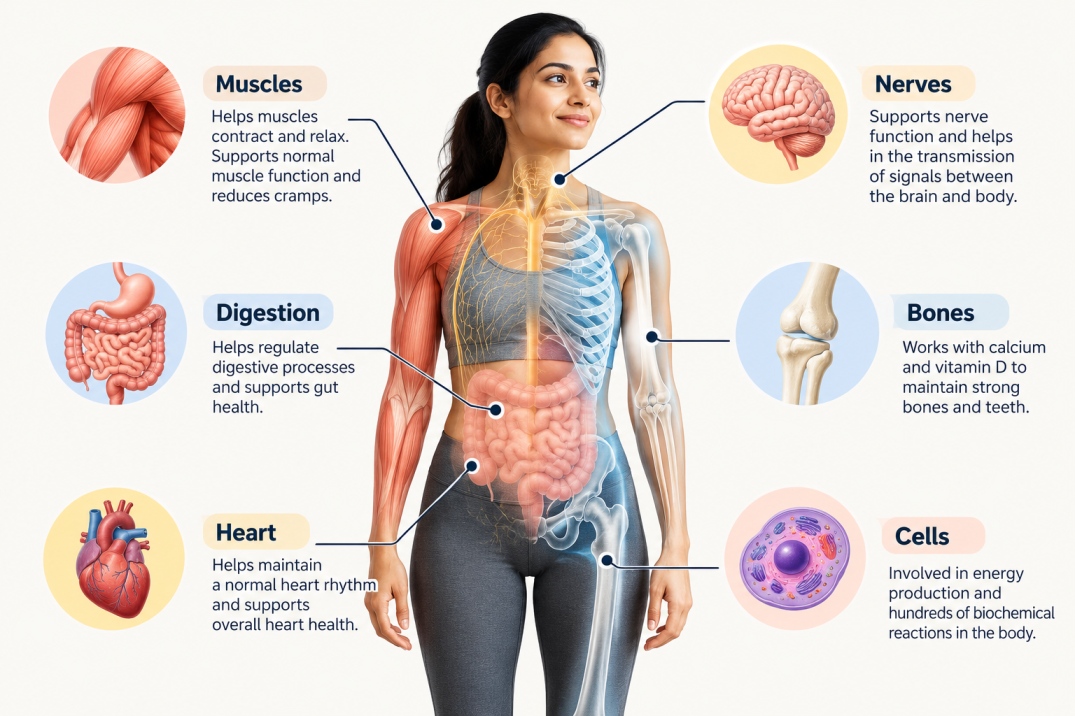
It is involved in hundreds of biochemical reactions, including processes related to muscle and nerve function, blood glucose regulation, protein production, bone health and DNA synthesis.
And the good news?
You don't need exotic "superfoods" to get magnesium.
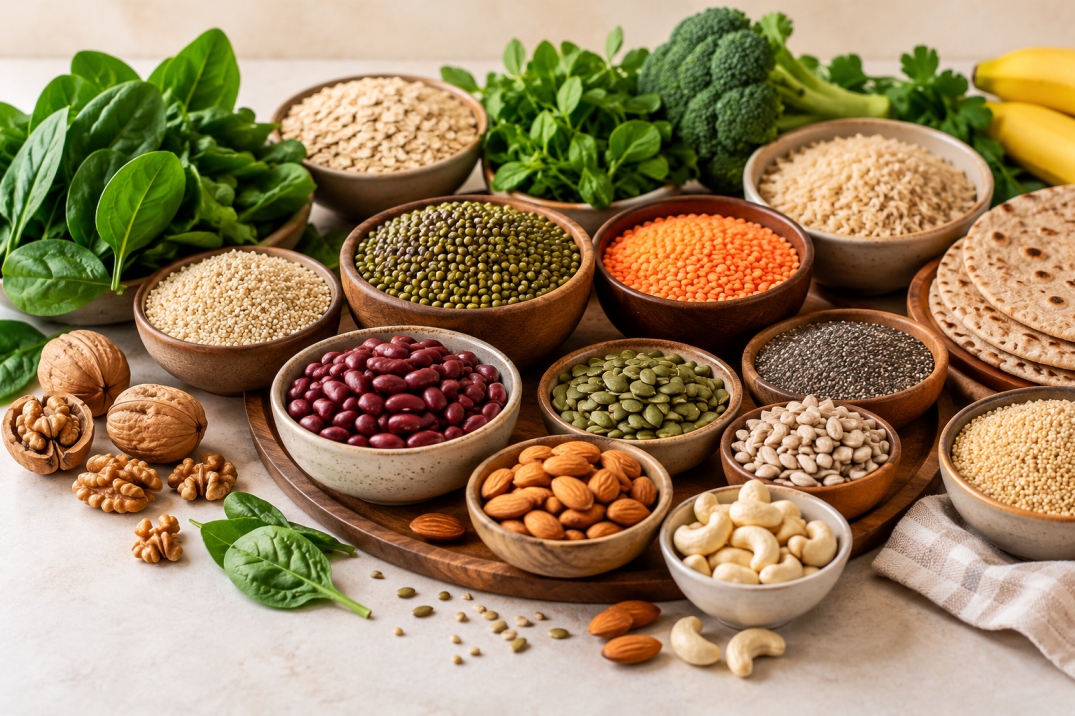
Many foods already found in an Indian kitchen can contribute meaningful amounts:
Dal and other legumes
Nuts
Seeds
Whole grains
Green leafy vegetables
Some dairy foods
Whole-food snacks
The bigger issue is that diets built heavily around refined grains, processed snacks and low vegetable intake may provide less magnesium than a varied whole-food diet.
So, how much do you actually need?
What happens when you don't get enough?
And which Indian foods should you add to your plate?
Let's break it down.https://ods.od.nih.gov/factsheets/magnesium-consumer/
What Is Magnesium?
Magnesium is an essential mineral.
Your body cannot make it, so you need to obtain it through food and, when appropriate, supplements.
Magnesium is involved in:
Muscle contraction and relaxation
Nerve function
Blood glucose regulation
Blood pressure regulation
Protein synthesis
Bone formation
DNA production
Normal energy metabolism
The NIH Office of Dietary Supplements describes magnesium as important for regulating muscle and nerve function, blood sugar and blood pressure, and for making protein, bone and DNA.https://ods.od.nih.gov/factsheets/magnesium-consumer/
Why Does Your Body Need Magnesium?
1. Magnesium Supports Muscle Function
Your muscles need magnesium for normal contraction and relaxation.
This includes:
Skeletal muscles
Smooth muscles
Cardiac muscle
Magnesium works alongside other electrolytes, particularly calcium and potassium, to support normal muscle and nerve function.
This is one reason magnesium is often discussed in relation to muscle cramps.
However, it is important not to assume that every muscle cramp means magnesium deficiency.
Cramps can have many causes, including:
Dehydration
Exercise
Electrolyte changes
Medication effects
Muscle fatigue
Other nutritional or medical factors
2. Magnesium Supports the Nervous System
Magnesium is involved in normal nerve signaling.
Your nervous system relies on carefully controlled movement of minerals and electrical signals across nerve and muscle cells.
Magnesium is part of this complex process.
However, this does not mean that taking a magnesium supplement automatically makes someone calmer or eliminates anxiety.
Adequate magnesium is important for normal physiology, but supplements should not be presented as a universal treatment for mental-health conditions.
3. Magnesium Helps Produce Protein
Magnesium is involved in protein synthesis.
That makes it relevant to anyone interested in:
Muscle health
Fitness
Recovery
Healthy aging
Maintaining lean body mass
But magnesium itself is not a substitute for adequate dietary protein.
Think of it as:
Protein provides the building material.
Magnesium helps support the biochemical processes that use those nutrients.
https://wellorafit.com/services/nutrition-diet-planning/
4. Magnesium Supports Bone Health
A large proportion of the body's magnesium is stored in bone.
Magnesium participates in bone formation and mineral metabolism.
But healthy bones require more than magnesium.
A broader bone-health strategy includes:
Magnesium + Calcium + Vitamin D + Protein + Physical Activity
This is particularly important as people age.
5. Magnesium Is Involved in Energy Metabolism
Your body needs magnesium for many reactions involved in converting food into usable energy.
This does not mean magnesium supplements provide an instant energy boost.
If you are deficient, correcting the deficiency may help resolve deficiency-related symptoms such as weakness or fatigue.
But if your magnesium intake is already adequate:
More magnesium does not automatically mean more energy.
6. Magnesium Helps Maintain Normal Blood Glucose Regulation
Magnesium participates in processes involved in glucose metabolism and insulin action.
However, magnesium supplements should not be promoted as a treatment for diabetes.
For blood glucose management, the bigger picture includes:
Overall diet
Carbohydrate quality
Fiber
Physical activity
Body composition
Sleep
Medication when prescribed
7. Magnesium Is Involved in DNA Production
Magnesium participates in the synthesis of DNA and other cellular processes.
Because these processes occur continuously, adequate magnesium is required throughout life.
How Much Magnesium Do You Need?
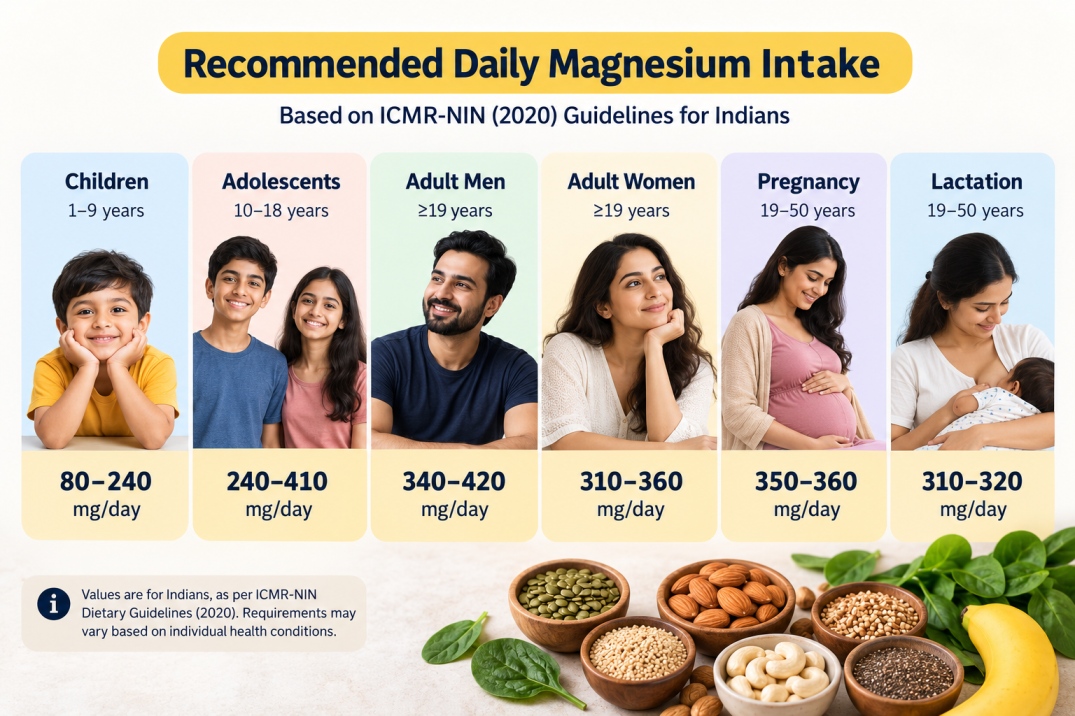
Magnesium requirements vary according to age and sex.
The NIH recommendations for adults are:
Group
Recommended Magnesium
Adult men 19–30 years
400 mg/day
Adult men 31+ years
420 mg/day
Adult women 19–30 years
310 mg/day
Adult women 31+ years
320 mg/day
Pregnant women
350–360 mg/day
Breastfeeding women
310–320 mg/day
These are general reference values and should not be interpreted as a treatment target for someone with diagnosed magnesium deficiency.
For Indian dietary planning, ICMR-NIN provides its own nutrient-requirement framework and recommends obtaining nutrients through a varied dietary pattern rather than relying on isolated foods or supplements.
What Foods Contain Magnesium?
Magnesium occurs naturally in many plant foods.
Some of the best dietary categories include:
Nuts
Almonds
Cashews
Peanuts
Seeds
Pumpkin seeds
Sesame seeds
Flaxseeds
Chia seeds
Sunflower seeds
Legumes
Moong
Masoor
Chickpeas
Rajma
Lobia
Soybeans
Whole Grains
Oats
Whole wheat
Brown rice
Barley
Millets
Green Leafy Vegetables
Spinach
Amaranth leaves
Methi
Other leafy greens
Dairy
Milk
Curd
Some other dairy foods
The NIH specifically identifies legumes, nuts, seeds, whole grains, green leafy vegetables and some milk products as useful magnesium sources.https://wellorafit.com/services/nutrition-diet-planning/
Best Magnesium-Rich Indian Foods
1. Pumpkin Seeds
Pumpkin seeds are among the more concentrated food sources of magnesium.
They can be added to:
Oatmeal
Curd
Salads
Smoothies
Homemade trail mixes
Because seeds are calorie-dense, a small portion is generally enough.
2. Sesame Seeds
Sesame seeds are particularly practical in Indian cooking.
Use them in:
Til chutney
Vegetable preparations
Laddoos in controlled portions
Homemade seed mixes
Salad toppings
They also provide healthy fats and other minerals.
3. Almonds
Almonds provide magnesium along with:
Protein
Healthy fats
Vitamin E
Fiber
A small serving can be an easy addition to breakfast or a snack.
But remember:
A handful of nuts is not a free food.
Nuts are nutrient-dense but also calorie-dense.
4. Peanuts
Peanuts are affordable and widely available in India.
They can be included in:
Poha
Chutneys
Chaat
Peanut salad
Roasted peanut snacks
They provide magnesium, protein and healthy fats.
5. Cashews
Cashews also contribute magnesium and can be used in moderate portions.
They can be added to:
Vegetable dishes
Homemade trail mixes
Snacks
Breakfast bowls
Avoid turning a healthy food into a high-calorie snack simply by increasing the portion excessively.
6. Dal and Lentils
This is where magnesium becomes particularly easy to include in an Indian diet.
Examples:
Moong dal
Masoor dal
Chana dal
Toor dal
Urad dal
Dal also contributes:
Protein
Fiber
Folate
Other minerals
This makes it an excellent everyday food rather than something you need to eat only for magnesium.
7. Chickpeas
Chickpeas can be used as:
Chole
Chana chaat
Chana salad
Roasted chana
Chickpea curry
They provide magnesium alongside protein and fiber.
8. Rajma
Rajma is another useful magnesium-containing legume.
A balanced meal could be:
Rajma + rice + vegetables + salad
This provides a combination of:
Protein
Fiber
Magnesium
Other micronutrients
9. Soybeans and Soy Foods
Soybeans contain magnesium along with protein and other nutrients.
Other soy foods such as tofu can also contribute magnesium, although amounts vary between products.
Try:
Tofu bhurji
Soybean curry
Tofu vegetable stir-fry
Soy-based curries
10. Whole Grains
Whole grains retain more of the grain's original structure and nutrients than refined grains.
Examples include:
Oats
Whole wheat
Barley
Brown rice
Jowar
Bajra
Ragi
Whole grains can contribute magnesium while also providing fiber.
This is another reason to vary your grain choices rather than relying entirely on refined cereals.
11. Green Leafy Vegetables
Leafy vegetables such as spinach and amaranth provide magnesium along with:
Folate
Vitamin K
Carotenoids
Fiber
Other micronutrients
Try including leafy vegetables regularly rather than occasionally.
12. Dark Chocolate
Cocoa and dark chocolate can contain magnesium.
However, this does not mean chocolate should become your main magnesium strategy.
Choose products with a higher cocoa content and control portions because chocolate can also contain substantial calories and added sugar.
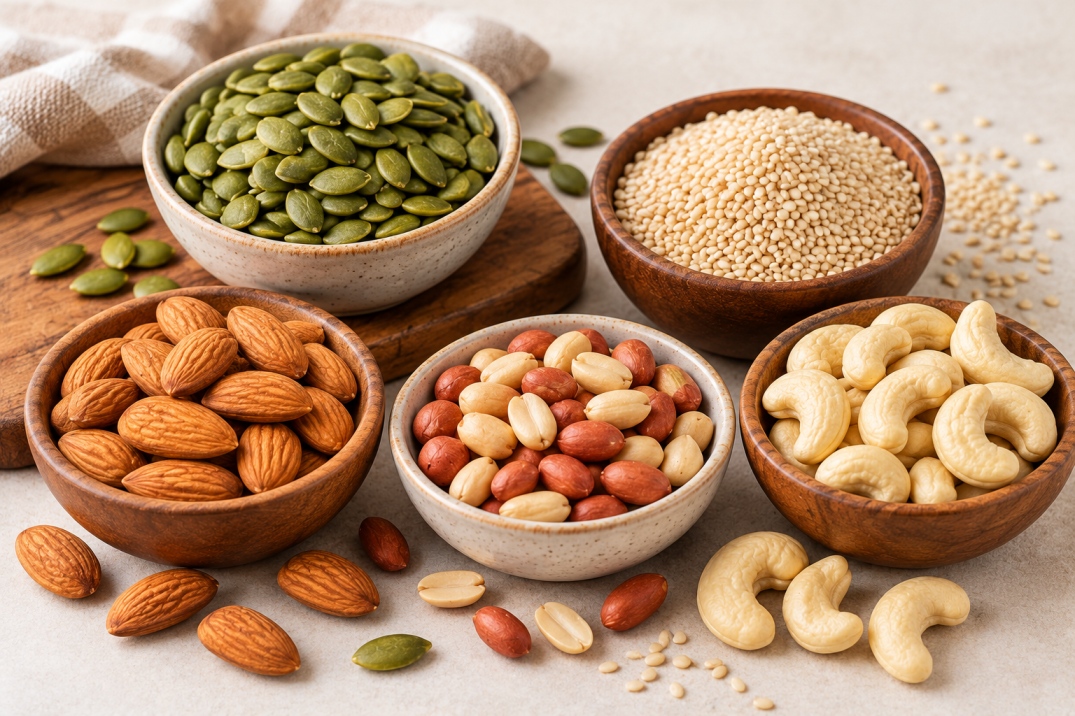
Magnesium-Rich Foods at a Glance
Food Group
Examples
Practical Use
Seeds
Pumpkin, sesame, chia, flax
Toppings, chutneys, breakfast
Nuts
Almonds, cashews, peanuts
Snacks, toppings
Legumes
Moong, masoor, rajma, chole
Dal, curry, chaat
Whole grains
Oats, barley, whole wheat, millets
Breakfast, roti, meals
Leafy greens
Spinach, amaranth, methi
Sabzi, dal
Soy
Soybeans, tofu
Curry, bhurji
Dairy
Milk, curd
Meals, snacks
Cocoa
Dark chocolate
Small occasional portion
Why Whole Foods Are Better Than Chasing a Single "Superfood"
You do not need to eat pumpkin seeds every day just because they contain magnesium.
A better strategy is dietary variety.
For example:
Breakfast: oats + nuts/seeds
Lunch: dal + whole grain + vegetables
Snack: roasted chana
Dinner: rajma/tofu + vegetables
Across the day, multiple foods contribute small and moderate amounts of magnesium.
This is how a balanced diet works.
Can a Vegetarian Diet Provide Enough Magnesium?
Yes.
This is actually one area where a varied vegetarian diet can have many advantages.
Plant foods such as:
Legumes
Whole grains
Nuts
Seeds
Green leafy vegetables
are important magnesium sources.
The challenge is not vegetarianism itself.
The challenge is a low-variety, highly processed vegetarian diet.
For example:
Less nutrient-dense pattern
White bread + biscuits + refined noodles + sugary drinks
versus
More nutrient-dense pattern
Oats + dal + whole grains + vegetables + nuts/seeds + legumes
The second pattern naturally provides a broader range of micronutrients.
What About Magnesium in an Indian Diet?
Indian diets already contain many magnesium-rich foods.
Traditional foods such as:
Dal
Chana
Rajma
Lobia
Peanuts
Sesame
Millets
Whole wheat
Green leafy vegetables
can all contribute.
This is one reason ICMR-NIN emphasizes dietary diversity and inclusion of different food groups in its Dietary Guidelines for Indians 2024.
Rather than adding a supplement immediately, first ask:
"Does my daily diet regularly include legumes, whole grains, vegetables, nuts and seeds?"
Magnesium and Weight Loss
Magnesium is sometimes marketed as a "fat-burning mineral."
That's misleading.
Magnesium is involved in normal energy metabolism, but magnesium supplements do not directly burn body fat.
For weight management, focus on:
Appropriate calorie intake
Protein-rich meals
High-fiber foods
Vegetables
Whole grains
Regular physical activity
Adequate sleep
Magnesium should be part of a nutritious diet, not a weight-loss shortcut.
Magnesium and Muscle Cramps
This is one of the most common reasons people take magnesium supplements.
But the relationship is more complicated than:
"Cramps = magnesium deficiency."
Magnesium deficiency can cause muscle contractions, cramps and abnormal neuromuscular function when deficiency becomes significant.
However, ordinary exercise-related cramps do not automatically indicate magnesium deficiency.
Before taking high-dose magnesium, consider:
Hydration
Exercise load
Other electrolytes
Recovery
Medications
Underlying medical conditions
Persistent or severe cramps deserve appropriate evaluation.

Magnesium and Sleep
Magnesium is often promoted as a natural sleep remedy.
There is a biological reason people make this connection because magnesium participates in nervous-system function.
However, this does not mean magnesium supplements are guaranteed to improve sleep in everyone.
If your diet is inadequate or you have a deficiency, correcting that nutritional problem is important.
But for better sleep, also address:
Consistent sleep timing
Morning light exposure
Regular physical activity
Caffeine timing
Screen use before bed
Stress
Sleep environment
Magnesium should not replace good sleep habits.
Magnesium and Stress
Magnesium is involved in normal nervous-system function, but it should not be presented as a cure for stress or anxiety.
A balanced diet can support overall nutritional status, while persistent anxiety or significant stress may require other forms of support.
Magnesium and Heart Health
Magnesium is involved in normal muscle and nerve function and blood-pressure regulation.
However, magnesium supplements should not replace:
Blood-pressure treatment
A heart-healthy diet
Physical activity
Medical care
People with cardiovascular conditions should discuss supplementation with their healthcare professional.
What Happens If You Don't Get Enough Magnesium?
A diet that is slightly low in magnesium does not necessarily cause immediate symptoms.
The body can conserve magnesium by reducing losses through the kidneys.
But prolonged low intake, certain diseases or medications can contribute to deficiency.
Possible symptoms of significant deficiency include:
Loss of appetite
Nausea
Vomiting
Fatigue
Weakness
More severe deficiency may cause:
Numbness
Tingling
Muscle cramps
Seizures
Personality changes
Abnormal heart rhythm
Severe magnesium deficiency is uncommon in otherwise healthy people, but risk increases with certain medical conditions and medications.
Who Is at Higher Risk of Magnesium Deficiency?
Certain groups deserve more attention.
People With Gastrointestinal Disorders
Conditions such as:
Crohn's disease
Celiac disease
Other gastrointestinal disorders
can affect magnesium absorption or losses.
People With Type 2 Diabetes
People with type 2 diabetes may have a higher risk of low magnesium status.
This does not mean every person with diabetes needs a magnesium supplement.
Dietary quality and individual assessment matter.
People With Long-Term Alcohol Use
Long-term excessive alcohol intake can increase the risk of magnesium deficiency.
People Taking Certain Medications
Some medications can affect magnesium levels.
Examples can include certain:
Diuretics
Acid-reducing medicines
Other medications that alter magnesium absorption or urinary losses
If you take long-term medication, don't stop it because of a nutrition article.
Instead, discuss possible nutrient effects with your healthcare professional.
Can Magnesium Deficiency Be Diagnosed From Symptoms?
Not reliably.
Symptoms such as:
Fatigue
Weakness
Muscle cramps
can have many causes.
A healthcare professional may assess your:
Diet
Medical history
Medication use
Symptoms
Relevant laboratory tests
depending on the situation.
Do not assume that every symptom is caused by magnesium deficiency.
Magnesium Supplements: Do You Need One?
For most healthy people, the first approach should be:
Food first.
A varied diet containing legumes, nuts, seeds, whole grains and vegetables can provide magnesium.
A supplement may be appropriate when:
A deficiency is diagnosed
A medical condition increases requirements or losses
Dietary intake is inadequate
A healthcare professional recommends it
The correct product and dose depend on the individual.
Magnesium Supplements Come in Different Forms
Magnesium supplements are available in different forms, including:
Magnesium citrate
Magnesium chloride
Magnesium lactate
Magnesium aspartate
Magnesium oxide
Other forms
The forms differ in absorption and tolerability.
The NIH notes that magnesium citrate, lactate, chloride and aspartate are among the forms that are more readily absorbed than some others.
This does not mean one form is automatically "best" for everyone.
Can Too Much Magnesium Be Harmful?
Yes.
Magnesium naturally present in foods is generally not a concern for healthy people because the kidneys can remove excess magnesium.
The situation is different with supplements and magnesium-containing medications.
Excess supplemental magnesium can cause:
Diarrhea
Nausea
Abdominal cramping
Very high amounts can be dangerous, particularly in people with impaired kidney function.
The NIH sets an upper limit for magnesium from supplements and medications, separate from magnesium naturally occurring in food.
So:
Food magnesium ≠ supplement magnesium.
Don't assume that because a mineral is essential, taking very high doses is harmless.
Magnesium and Kidney Disease
This is particularly important.
The kidneys help remove excess magnesium.
If kidney function is impaired, magnesium can accumulate more easily.
Therefore, people with kidney disease should not start magnesium supplements without medical guidance.
Magnesium and Other Nutrients
Magnesium doesn't work in isolation.
It interacts with many nutrients and electrolytes.
For overall health, focus on dietary patterns containing:
Magnesium
Calcium
Potassium
Vitamin D
Protein
Fiber
Other micronutrients
A varied diet is much more useful than trying to optimize one mineral while neglecting everything else.
Does Cooking Reduce Magnesium?
Cooking can alter the mineral content of foods, particularly when water-soluble minerals move into cooking water.
However, cooking does not mean that magnesium-rich foods suddenly become poor sources.
For foods such as:
Dal
Beans
Leafy vegetables
the best approach is simply to use appropriate cooking methods and consume a varied diet.
There is no need to avoid cooked vegetables because of magnesium concerns.
Does Soaking or Sprouting Affect Magnesium?
Legumes, grains, nuts and seeds contain compounds such as phytates that can bind minerals.
Traditional food preparation methods such as:
Soaking
Sprouting
Fermentation
Cooking
can alter these compounds and improve digestibility and mineral bioavailability in some foods.
This is another reason traditional Indian food preparation can be nutritionally useful.
However, you don't need to obsess over mineral absorption from every meal.
Variety and overall dietary quality matter most.
A Magnesium-Rich Indian Breakfast
Instead of:
Tea + biscuits
try:
Option 1
Oats + milk/curd + nuts and seeds
Option 2
Vegetable poha + peanuts
Option 3
Moong dal chilla + curd
Option 4
Whole-wheat vegetable upma + seeds
These meals provide more nutrients overall and can contribute magnesium.
A Magnesium-Rich Indian Lunch
Try:
2 rotis + dal + leafy vegetable + curd
or:
Rajma + controlled rice portion + vegetables
or:
Chole + roti + vegetable + salad
These combinations provide magnesium alongside protein, fiber and other nutrients.
Magnesium-Rich Snack Ideas
Instead of highly processed snacks, consider:
Roasted chana
Small portion of almonds
Peanuts
Seed mix
Fruit + nuts
Curd + seeds
Remember that nuts and seeds are nutrient-dense but calorie-dense.
Magnesium-Rich Dinner Ideas
Option 1
Dal + roti + leafy vegetable
Option 2
Rajma + rice + vegetables
Option 3
Tofu + vegetables + roti
Option 4
Moong dal khichdi + curd
Option 5
Chole + roti + vegetable
A varied vegetarian diet can naturally incorporate magnesium without requiring a supplement at every meal.
A Simple One-Day Magnesium-Friendly Indian Diet
This is an example of food combinations, not an individualized diet prescription.
Early Morning
Water
Breakfast
Vegetable poha + peanuts + fruit
Mid-Morning
Fruit + small portion of almonds
Lunch
2 rotis + dal + leafy vegetable + curd
Evening
Roasted chana
Dinner
Rajma + controlled rice portion + mixed vegetables
Optional
Seeds added to curd, salad or breakfast in a moderate portion
This type of day provides multiple opportunities to obtain magnesium from whole foods.
Magnesium and Weight Management: The Better Approach
Instead of searching for a magnesium supplement for weight loss, build meals around foods that naturally contain magnesium.
For example:
Dal + vegetables + whole grain + seeds
is far more useful than:
Processed meal + magnesium tablet
because the whole-food meal also provides:
Fiber
Protein
Other minerals
Vitamins
Plant compounds
This is the WelloraFit approach:
Improve the whole dietary pattern, not just one nutrient.
7 Easy Ways to Get More Magnesium From Food
1. Add Seeds
Sprinkle pumpkin, sesame, chia or flax seeds over meals.
2. Eat Dal Regularly
Rotate different dals rather than relying on only one.
3. Choose Whole Grains More Often
Use oats, whole wheat, barley and millets regularly.
4. Include Leafy Greens
Add spinach, amaranth or methi to meals.
5. Use Nuts as a Smart Snack
Keep portions moderate.
6. Include Beans
Rotate rajma, chole, lobia and other legumes.
7. Reduce Highly Processed Foods
Replacing refined, nutrient-poor snacks with whole foods naturally improves the overall micronutrient profile of the diet.
Common Magnesium Myths
Myth 1: Everyone With Muscle Cramps Needs Magnesium
Fact: Cramps have many possible causes. Magnesium deficiency is only one possibility.
Myth 2: Magnesium Supplements Automatically Improve Sleep
Fact: Magnesium is involved in normal nervous-system function, but supplementation does not guarantee better sleep for everyone.
Myth 3: Magnesium Burns Fat
Fact: Magnesium is involved in energy metabolism, but it is not a fat-burning supplement.
Myth 4: More Magnesium Is Better
Fact: Excess supplemental magnesium can cause side effects and, at very high levels, serious toxicity.
Myth 5: You Need a Supplement to Get Enough Magnesium
Fact: Many foods naturally provide magnesium, especially legumes, nuts, seeds, whole grains and leafy vegetables.
Myth 6: Nuts Are the Only Good Source
Fact: Dal, beans, whole grains, seeds and leafy vegetables also contribute magnesium.
Myth 7: Magnesium Deficiency Is Always Obvious
Fact: Mildly low intake may not cause obvious symptoms, and significant deficiency can have different manifestations.
Magnesium vs Other Important Minerals
Nutrient
Main Roles
Magnesium
Muscle/nerve function, protein synthesis, bone, energy metabolism
Calcium
Bones, teeth, muscle contraction, nerve signaling
Potassium
Fluid balance, nerve and muscle function
Iron
Haemoglobin and oxygen transport
Zinc
Immune function, wound healing, enzymes
The goal isn't to choose one "best" mineral.
Your body needs all of them in appropriate amounts.
Magnesium for Women
Magnesium is relevant to women throughout life.
Dietary needs remain important during:
Adolescence
Reproductive years
Pregnancy
Breastfeeding
Older adulthood
Pregnancy increases magnesium requirements compared with non-pregnant adult women according to NIH reference values.
However, pregnancy is not a reason to start high-dose magnesium supplements without professional advice.
A varied diet containing:
Legumes
Whole grains
Nuts
Seeds
Green vegetables
Dairy where appropriate
can provide magnesium alongside other nutrients.
Magnesium and Healthy Aging
As people age, maintaining adequate intake of minerals becomes increasingly important.
A balanced diet combined with:
Strength training
Adequate protein
Calcium
Vitamin D
Regular movement
supports muscle and bone health.
Magnesium is one part of this bigger picture.
When Should You Talk to a Healthcare Professional?
Seek professional advice if you have:
Persistent muscle cramps
Unexplained weakness
Persistent fatigue
Numbness or tingling
Abnormal heart rhythm
Significant gastrointestinal disease
Kidney disease
Long-term medication use that may affect magnesium
A diagnosed electrolyte abnormality
Don't assume a supplement is the solution before identifying the cause.
Key Takeaways
Magnesium is an essential mineral involved in hundreds of body processes.
It supports muscle and nerve function, protein production, bone health, glucose regulation and energy metabolism.
Adult magnesium requirements generally range around 310–420 mg/day, depending on age and sex.
Good food sources include legumes, nuts, seeds, whole grains and green leafy vegetables.
Indian foods such as dal, rajma, chole, peanuts, sesame, whole grains, millets and leafy vegetables can contribute magnesium.
A varied vegetarian diet can provide substantial magnesium.
Magnesium deficiency is more likely in certain medical conditions and with some medications.
Muscle cramps do not automatically mean magnesium deficiency.
Magnesium is not a magic treatment for weight loss, anxiety or poor sleep.
Food should generally be the first source of magnesium.
Supplements can be useful when dietary intake is inadequate or when medically indicated.
Excess magnesium from supplements or medications can cause adverse effects.
People with impaired kidney function should be particularly careful with magnesium supplementation.
Conclusion
Magnesium may be a "small" part of your nutrition label, but its role in the body is anything but small.
It supports muscles, nerves, bones, protein synthesis, energy metabolism and many other physiological processes.
And you don't need expensive powders or exotic foods to get it.
An Indian diet can provide magnesium through everyday foods such as:
Dal + beans + whole grains + leafy vegetables + nuts + seeds
For example:
Moong dal + roti + leafy vegetable
or
Rajma + rice + vegetables
or
Oats + nuts and seeds
can all contribute to your daily magnesium intake.
The bigger lesson is that micronutrients work best as part of a varied dietary pattern, not as isolated supplements.
If your diet regularly includes legumes, whole grains, vegetables, nuts and seeds, you're already giving your body many opportunities to obtain magnesium.
And if you have persistent symptoms or a medical condition that increases your risk of deficiency, don't self-diagnose.
Build the diet first. Test when appropriate. Supplement when needed.
That is a much more sustainable approach to magnesium—and to nutrition overall.
FAQ
1. What does magnesium do in the body?
Magnesium supports muscle and nerve function, blood glucose regulation, blood pressure regulation, protein production, bone health and DNA synthesis.
2. How much magnesium do adults need?
Adult requirements vary by age and sex. Men generally need about 400–420 mg/day, while women generally need about 310–320 mg/day. Pregnancy increases requirements.
3. Which Indian foods are rich in magnesium?
Useful options include dal, rajma, chole, peanuts, sesame seeds, pumpkin seeds, almonds, whole grains, millets and green leafy vegetables.
4. Can vegetarians get enough magnesium?
Yes. Legumes, whole grains, nuts, seeds and leafy vegetables are all good dietary sources of magnesium.
5. Does magnesium help with muscle cramps?
Magnesium deficiency can cause muscle cramps, but not every muscle cramp is caused by magnesium deficiency. Persistent cramps should be evaluated rather than automatically treated with supplements.
6. Does magnesium help with sleep?
Magnesium is involved in normal nervous-system function, but supplementation does not guarantee better sleep. Sleep habits and other underlying factors also matter.
7. Does magnesium help with weight loss?
Magnesium is involved in energy metabolism, but magnesium supplements are not a weight-loss treatment.
8. Can I get enough magnesium from food?
Yes. Many people can meet their needs through a varied diet containing legumes, nuts, seeds, whole grains and green leafy vegetables.
9. Should I take a magnesium supplement every day?
Not necessarily. Supplements may be useful for certain people, but they are not automatically required if dietary intake is adequate.
10. Can too much magnesium be harmful?
Yes. Excess magnesium from supplements or magnesium-containing medicines can cause diarrhea, nausea and abdominal cramping, while very high amounts can be dangerous.
11. Who is at higher risk of magnesium deficiency?
People with certain gastrointestinal diseases, type 2 diabetes, long-term excessive alcohol use and some medication exposures may be at increased risk.
12. Is magnesium important for bones?
Yes. Magnesium contributes to normal bone formation and mineral metabolism, but bone health also depends on calcium, vitamin D, protein and physical activity.
Ready to Begin Your Health Journey?
Get a personalized, medically guided plan built around your unique biology.