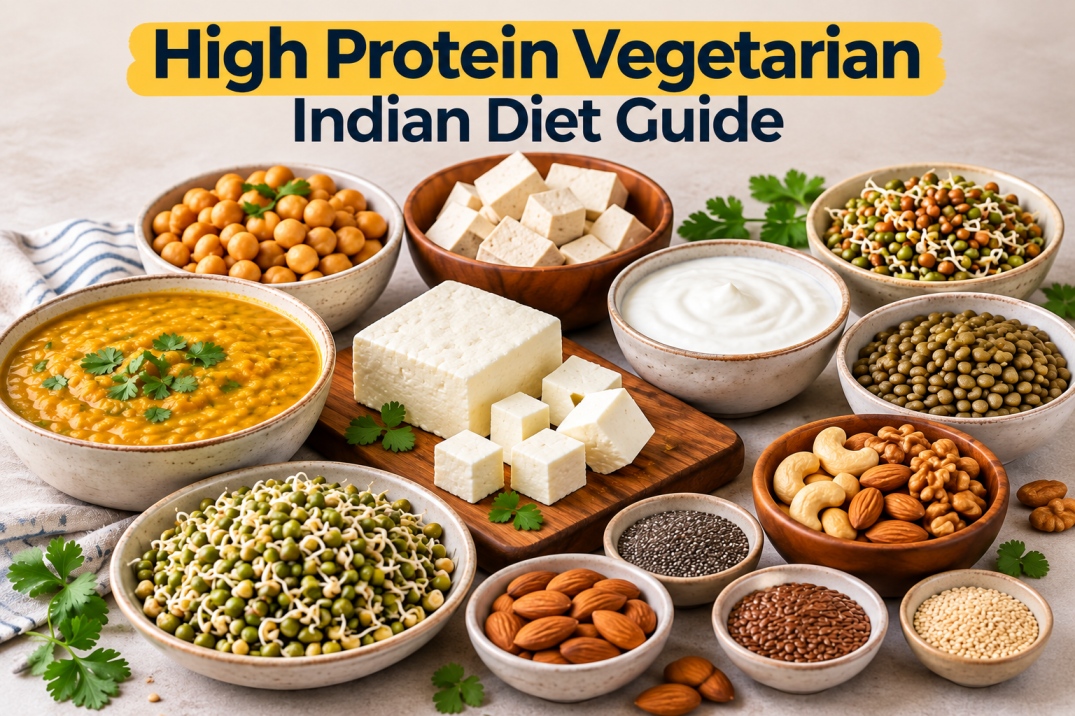
High Protein Vegetarian Indian Diet Guide
"Vegetarian food doesn't have enough protein."
You've probably heard this before.
But it is not quite that simple.
A well-planned vegetarian diet can provide adequate protein through a combination of pulses, beans, dairy, soy foods, nuts, seeds, whole grains and other plant foods.
The bigger challenge is often not the complete absence of protein.
It is that many Indian vegetarian meals are built mainly around cereals such as roti, rice, poha or bread, with only a small amount of protein-rich food added.
For example:
2 rotis + sabzi
may be a perfectly normal meal, but it may not provide as much protein as:
2 rotis + dal + sabzi + curd
The difference is not that roti contains no protein.
The difference is that the second meal deliberately includes a stronger protein source.
According to ICMR–NIN, the recommended dietary allowance for protein for healthy adults is 0.83 g per kg body weight per day. For a 65 kg adult, this corresponds to about 54 g protein per day. ICMR-NIN also emphasizes dietary diversity and explains that combining cereals with pulses helps provide a more complementary essential amino-acid profile.
So, how can you actually get enough protein from an Indian vegetarian diet?
The answer is not to eat protein bars all day.
It starts with building better meals.https://www.nin.res.in/dietaryguidelines/
Why Is Protein Important?
Protein is one of the three major macronutrients, along with carbohydrates and fats.
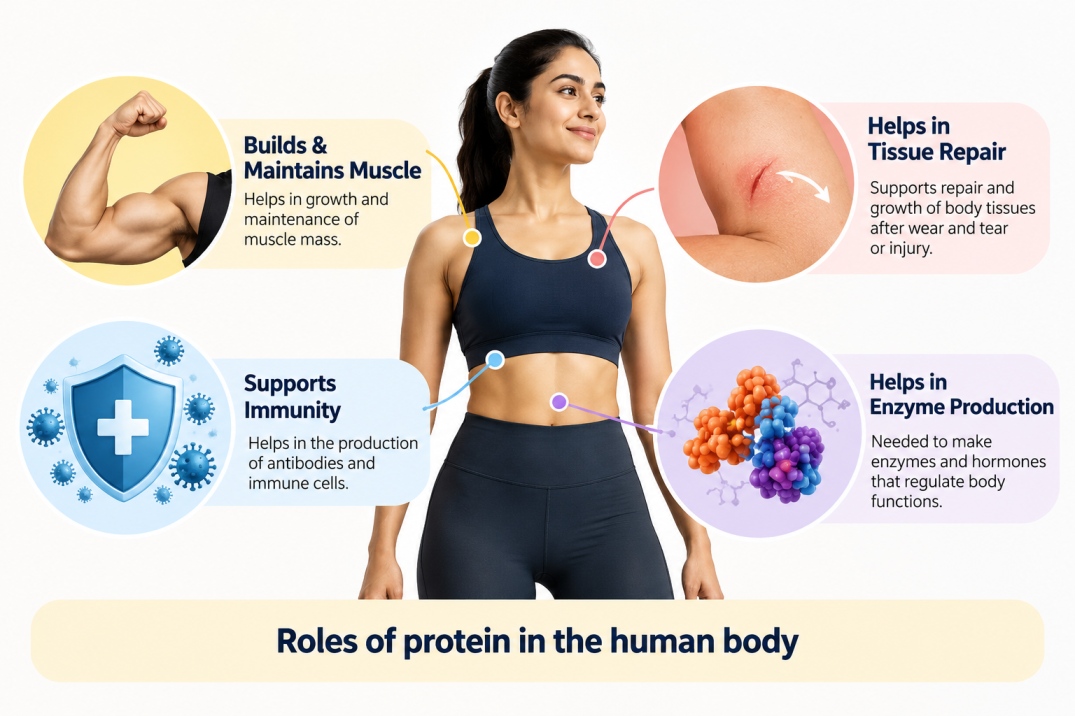
Your body uses protein to:
Build and maintain muscles
Support tissue repair
Produce enzymes
Make hormones and other proteins
Support immune function
Maintain skin, hair and nails
Support bones and connective tissues
Help maintain lean body mass
Protein is especially important when you're trying to lose weight.
During weight loss, the goal should not simply be to make the number on the scale smaller.
You also want to preserve as much lean mass as possible.
Adequate protein, combined with appropriate physical activity—particularly resistance exercise—can support muscle maintenance.
ICMR-NIN also emphasizes maintaining good muscle mass and recommends regular physical activity, including strength exercise, along with a good diet.https://www.nin.res.in/RDA_Full_Report_2024.html
How Much Protein Do You Actually Need?
Protein requirements are individual.
They depend on factors such as:
Body weight
Age
Physical activity
Training
Pregnancy or lactation
Health status
Energy intake
Specific nutritional goals
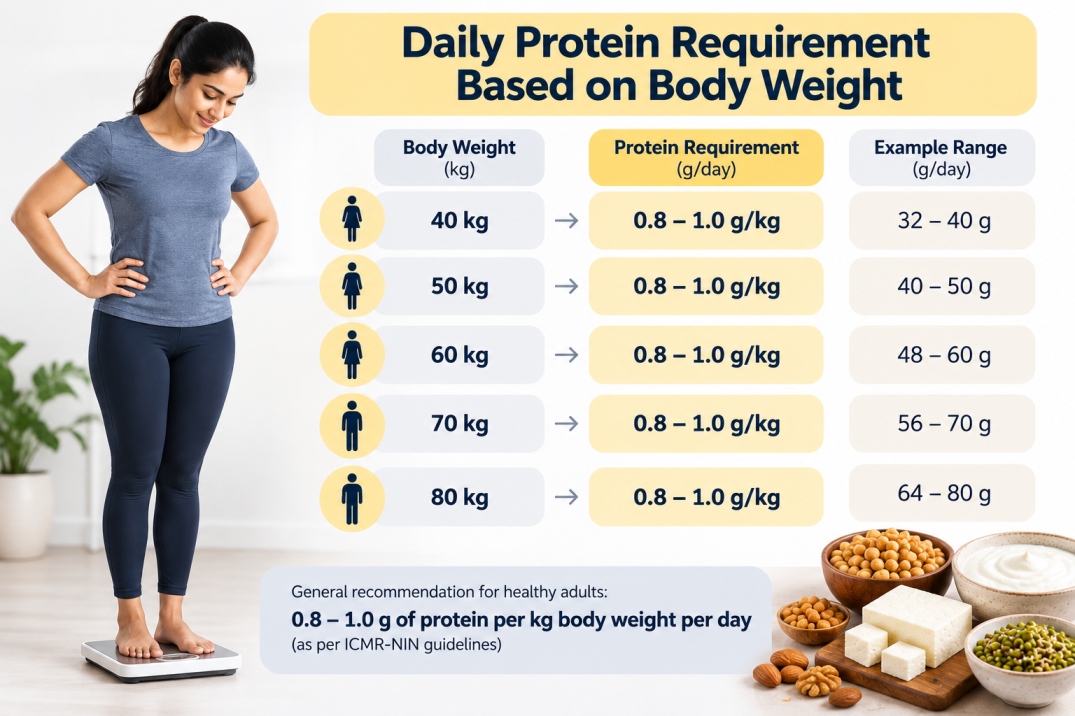
For healthy adults, the ICMR-NIN RDA is:
0.83 g protein/kg body weight/day.
Example
Body Weight
Approx. Protein RDA
50 kg
41.5 g/day
55 kg
45.7 g/day
60 kg
49.8 g/day
65 kg
54.0 g/day
70 kg
58.1 g/day
75 kg
62.3 g/day
80 kg
66.4 g/day
These are general requirements for healthy adults, not individualized therapeutic targets.
People who are highly active, older, pregnant, lactating, recovering from illness, or following a specific fitness or medical nutrition plan may require individualized recommendations.
Does an Indian Vegetarian Diet Provide Enough Protein?
It can.
The challenge is usually dietary pattern rather than vegetarianism itself.
ICMR-NIN notes that even diets consisting entirely of plant foods can meet protein requirements when the diet is diverse. However, protein quality and essential amino-acid composition need attention, particularly in diets that rely heavily on cereals.
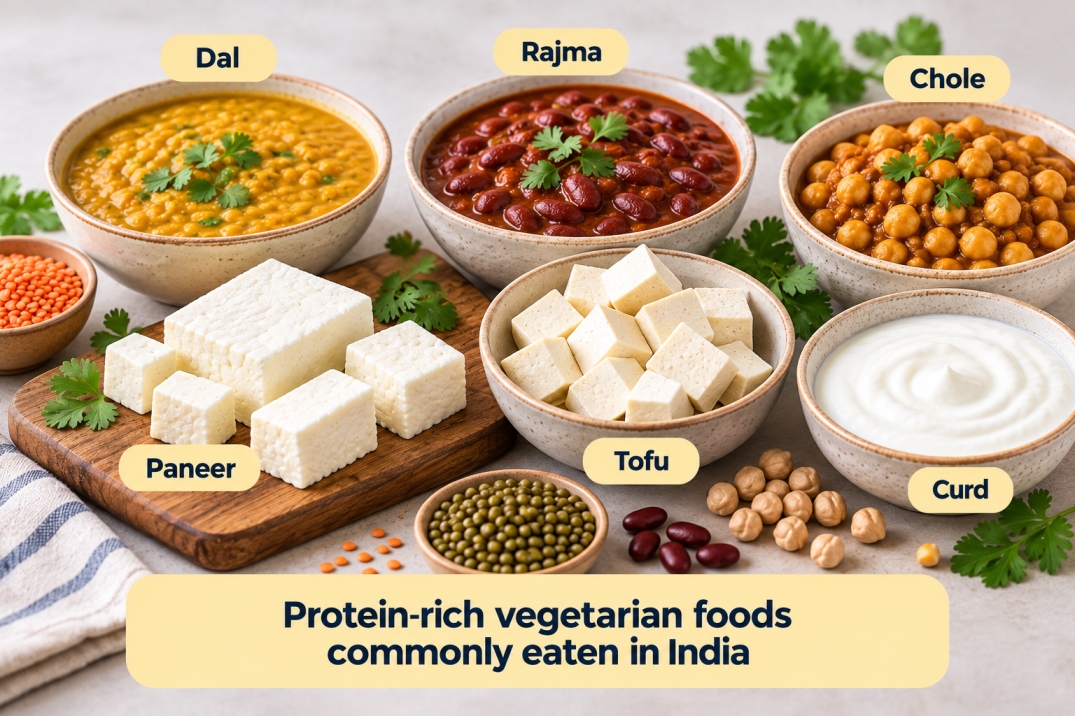
A typical Indian vegetarian diet can contain protein from:
Dal
Rajma
Chole
Lobia
Moong
Matki
Soybeans
Tofu
Tempeh
Paneer
Milk
Curd
Buttermilk
Peanuts
Nuts
Seeds
Whole grains
The goal is to include several of these sources across the day.https://wellorafit.com/services/nutrition-diet-planning/
The Biggest Protein Mistake in Vegetarian Indian Diets
One common mistake is thinking:
"I eat dal, so I get enough protein."
Dal is an excellent food, but the amount of protein in a serving depends on the type and portion.
Another common issue is that people may eat:
Lots of roti
Rice
Poha
Upma
Biscuits
Snacks
while protein-rich foods appear only occasionally.
This creates a diet that may provide plenty of calories but relatively little protein.
Instead of asking:
"What should I remove?"
ask:
"Where is my protein in this meal?"
The Best Vegetarian Protein Sources for an Indian Diet
1. Dal and Pulses
Dal is one of the most practical protein sources in Indian households.
Examples include:
Moong dal
Masoor dal
Toor dal
Chana dal
Urad dal
Pulses also provide:
Fiber
Iron
Folate
Magnesium
Other micronutrients
They can be included as:
Dal
Sambar
Dal khichdi
Dal chilla
Mixed dal
Dal-based curries
Practical Tip
Don't treat dal as just a side dish.
Make it a core part of the meal.
2. Chickpeas
Chickpeas are a useful combination of plant protein, carbohydrate and fiber.
They can be used in:
Chole
Chana salad
Chana chaat
Chana curry
Hummus
Roasted chana
Pairing chickpeas with vegetables and a whole grain creates a balanced meal.
3. Rajma
Rajma is another excellent Indian vegetarian staple.
A balanced meal could be:
Rajma + rice + vegetable + salad
Rather than having a very large serving of rice and a small amount of rajma, give the protein-rich component enough space on the plate.
4. Lobia
Lobia, or black-eyed peas, is another useful pulse.
Try:
Lobia curry
Lobia with roti
Lobia salad
Lobia and vegetable bowl
Rotating different legumes also improves dietary variety.
5. Soy Foods
Soy is one of the most useful vegetarian protein sources.
Examples include:
Soybeans
Tofu
Tempeh
Unsweetened soy milk
Soy chunks
Soy foods can make it easier to increase protein without relying entirely on dairy.
Easy Indian Options
Tofu bhurji
Soy chunk curry
Tofu vegetable stir-fry
Soybean curry
6. Paneer
Paneer is a convenient vegetarian protein source.
It can be included in:
Paneer bhurji
Paneer tikka
Palak paneer
Paneer vegetable curry
Paneer wraps
However, paneer also contains fat and calories.
If you're trying to lose weight, portion size and the type of paneer matter.
Avoid assuming that unlimited paneer is a "high-protein diet."
7. Milk and Curd
Milk and curd can contribute both protein and calcium.
Useful options include:
Plain milk
Curd
Greek-style yogurt
Unsweetened high-protein yogurt
Curd can easily be added to:
Lunch
Dinner
Breakfast
Snacks
Simple Combination
Dal + roti + sabzi + curd
can create a much more protein-supportive meal than roti and sabzi alone.
8. Peanuts
Peanuts contain protein as well as healthy fats.
They can be used in:
Chutneys
Poha
Chaat
Peanut salad
Homemade snacks
However, peanuts are energy-dense.
A small portion can be useful, but eating large amounts simply because they contain protein can add significant calories.
9. Nuts and Seeds
Nuts and seeds can contribute protein, healthy fats and micronutrients.
Examples include:
Almonds
Walnuts
Pistachios
Pumpkin seeds
Sunflower seeds
Sesame seeds
Flaxseeds
Chia seeds
They are excellent additions to a healthy diet, but they should not be treated as the primary protein source.
Why?
Because their protein comes along with a relatively high amount of fat and calories.
For someone trying to increase protein while controlling calories, dal, soy, dairy and other protein-rich foods may provide more protein per calorie.
10. Sprouts
Sprouted legumes such as:
Moong
Matki
Chickpeas
Moth beans
can contribute protein and fiber.
They can be used in:
Sprout chaat
Usal
Sprout curry
Chilla
Mixed vegetable dishes
For food safety, especially in higher-risk individuals, cooked sprouts are preferable to raw or lightly cooked sprouts.
11. Whole Grains
Whole grains are not usually the most concentrated protein source, but they contribute to total protein intake.
Examples include:
Whole wheat
Oats
Barley
Brown rice
Millets
Jowar
Bajra
Ragi
The important point is:
Grains can contribute protein, but they should not be your only protein strategy.
The Protein Complementation Concept
This is particularly relevant for vegetarian diets.
Different plant foods have different amino-acid profiles.
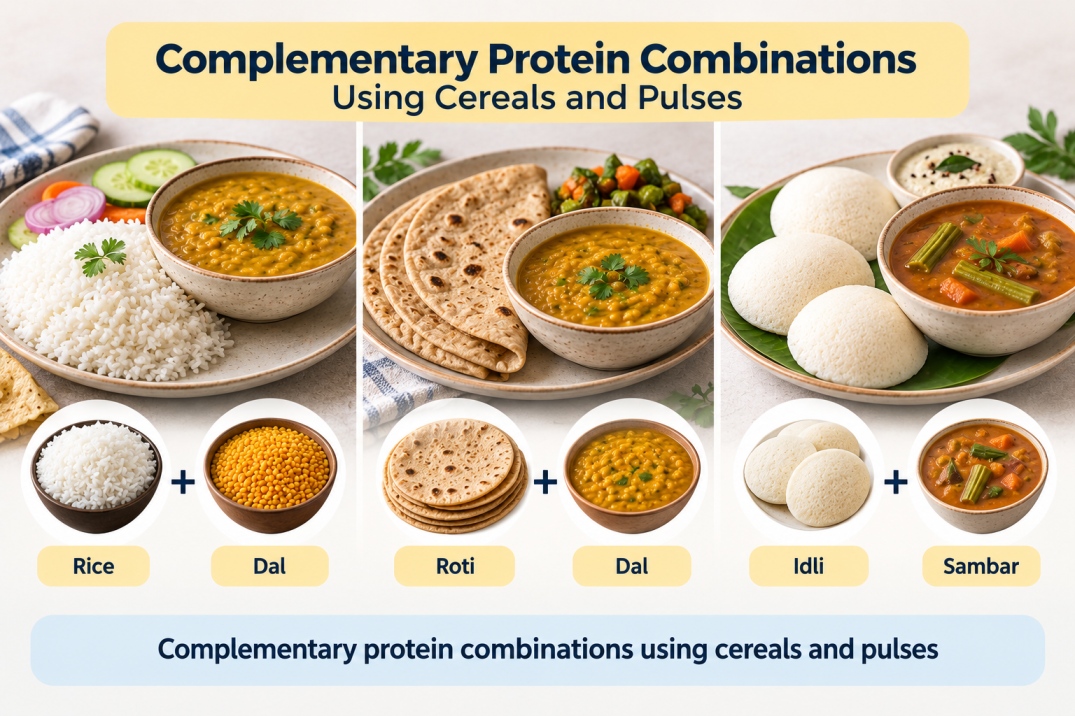
ICMR-NIN explains that cereals tend to be lower in lysine, while pulses tend to be lower in methionine and cysteine. Combining cereals with pulses helps complement these amino acids.
For example:
Rice + dal
Roti + dal
Khichdi
Idli + sambar
These combinations bring together different food sources.
ICMR-NIN specifically notes that a meal containing both pulses and grains provides a more complementary essential amino-acid profile than eating pulses or grains alone.
Do You Need to Combine Proteins at Every Meal?
You don't need to obsessively calculate amino acids at every meal.
The more practical approach is to eat a varied diet across the day.
Include different sources such as:
Pulses
Grains
Soy
Dairy
Nuts
Seeds
This provides dietary diversity and helps improve overall protein quality.
The goal is not to create a mathematically perfect plate.
The goal is to avoid relying almost entirely on one food group.https://wellorafit.com/services/nutrition-diet-planning/
Easy High-Protein Indian Meal Combinations
Here are practical combinations that can make a vegetarian diet more protein-focused.
Meal
Protein-Focused Combination
Breakfast
Moong dal chilla + curd
Breakfast
Besan chilla + paneer filling
Breakfast
Vegetable oats + curd
Breakfast
Idli + sambar
Lunch
Roti + dal + sabzi + curd
Lunch
Rajma + controlled rice portion + vegetables
Lunch
Chole + roti + salad
Lunch
Tofu/paneer + roti + vegetables
Snack
Roasted chana + fruit
Snack
Curd + nuts/seeds
Dinner
Dal + roti + sabzi
Dinner
Tofu bhurji + roti + vegetables
Dinner
Soy chunk curry + roti + salad
Dinner
Moong dal khichdi + curd
How to Build a High-Protein Vegetarian Breakfast
Breakfast is often where vegetarian diets become protein-light.
Common breakfasts such as:
Poha
Upma
Toast
Paratha
Cornflakes
can provide some protein but may not provide enough on their own.
Instead, add a deliberate protein source.
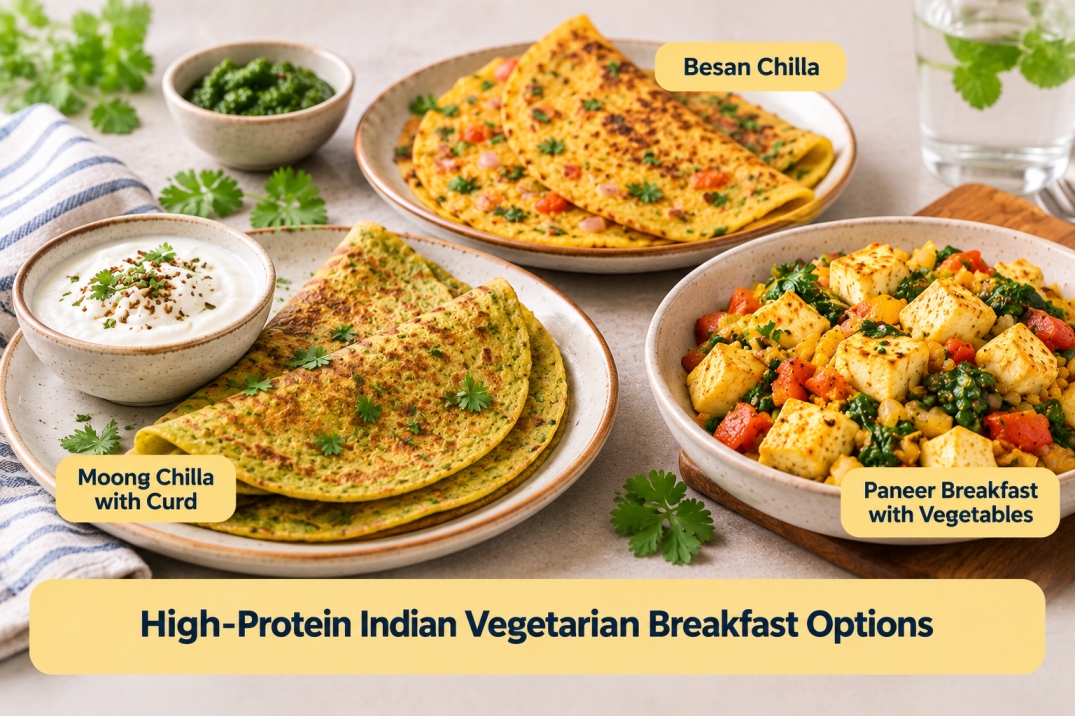
Example 1
Poha + peanuts + curd
Example 2
Moong dal chilla + curd
Example 3
Besan chilla + paneer filling
Example 4
Vegetable oats + curd
Example 5
Idli + generous serving of sambar
Example 6
Whole-wheat toast + paneer/tofu bhurji
The goal is simple:
Don't let breakfast be mostly carbohydrate.
How to Make Lunch More Protein-Rich
A simple Indian lunch formula works well:
Grain + Pulse/Protein + Vegetables + Optional Dairy
For example:
Option 1
2 rotis + 1 bowl dal + 1 bowl sabzi + curd
Option 2
Rice + rajma + vegetables + salad
Option 3
2 rotis + chole + sabzi
Option 4
Millet roti + dal + vegetable + curd
Option 5
Rice + sambar + vegetable + curd
The key is not simply adding more roti or rice.
Increase the protein-containing component.
How to Make Vegetarian Snacks More Protein-Rich
Many common Indian snacks are mainly refined carbohydrates.
Examples:
Biscuits
Namkeen
Chips
Bakery snacks
Sweetened beverages
Instead, try:
Roasted chana
Curd
Sprout chaat
Peanut chaat
Paneer cubes
Homemade besan chilla
Unsweetened soy milk
Fruit + small portion of nuts
A snack does not have to be large.
It simply needs to contribute meaningfully to the overall day's nutrition.
How to Make Dinner More Protein-Rich
Dinner often becomes:
Roti + sabzi
Add one protein source:
Roti + dal + sabzi
or
Roti + tofu + vegetables
or
Roti + paneer + vegetables
or
Soy curry + roti + salad
This one change can significantly improve the nutritional balance of the meal.
Protein for Vegetarian Weight Loss
Protein becomes particularly important during weight loss.
A higher-protein, nutrient-dense diet can help with:
Satiety
Meal satisfaction
Muscle maintenance
Better meal structure
But there is a common mistake:
"I'll just eat lots of paneer, nuts and peanut butter."
These foods contain protein, but they can also be calorie-dense.
For weight loss, focus on protein density.
Use a mixture of:
Dal
Beans
Soy
Tofu
Low-fat or appropriate dairy
Curd
Pulses
Vegetables
and use nuts, seeds and nut butters in controlled portions.
Protein for Muscle Building on a Vegetarian Diet
Vegetarian diets can support muscle development when they provide adequate:
Protein
Total energy
Essential amino acids
Micronutrients
Recovery
Resistance training
A common mistake is focusing only on protein powder.
You can build a strong food-based foundation using:
Dal + soy + dairy + beans + whole grains + nuts/seeds
If you're doing regular strength training, your total protein requirement may be higher than the general adult RDA and should be individualized according to training and goals.
Do Vegetarians Need Protein Powder?
Not necessarily.
Protein powder is a convenience product, not a requirement for a vegetarian diet.
Many people can meet their protein requirements through food.
Protein powder may be useful when:
Food intake is insufficient
Appetite is low
Time is limited
Protein requirements are unusually high
A convenient post-workout option is needed
But it should supplement a good diet rather than replace nutritious meals.
If you use a protein supplement, choose one appropriate for your dietary needs and consider the ingredient list, protein content, added sugar and overall calorie content.
Common Protein Mistakes in Indian Vegetarian Diets
1. Eating Protein Only at Lunch
Protein distribution throughout the day can make meals more balanced.
Instead of having almost all your protein at dinner, include a source at breakfast, lunch and dinner.
2. Counting Roti as the Main Protein Source
Roti does contribute some protein, but it is primarily a carbohydrate food.
Pair it with:
Dal + paneer + curd + beans + tofu
rather than depending on roti alone.
3. Eating Huge Portions of Nuts
Nuts are nutritious but energy-dense.
More nuts do not necessarily mean better protein intake.
4. Having Only Salad for Weight Loss
A vegetable salad without a protein source may not be a complete meal.
Add:
Chickpeas
Sprouts
Tofu
Paneer
Beans
Curd
depending on your dietary pattern.
5. Skipping Protein at Breakfast
Starting the day with only tea and biscuits or a carbohydrate-heavy breakfast can make it harder to distribute protein throughout the day.
6. Using Only Protein Powders
Supplements can be convenient, but whole foods provide a wider range of nutrients.
7. Eating More Food Instead of More Protein
Simply increasing your overall food intake can increase calories without adequately improving protein.
Choose protein-dense foods deliberately.
A Simple Protein Formula for Every Meal
You don't need to calculate every gram at every meal.
Use this simple question:
"Where is my protein?"
For breakfast:
Dal / besan / curd / milk / tofu
For lunch:
Dal / rajma / chole / paneer / tofu
For snack:
Curd / roasted chana / sprouts
For dinner:
Dal / soy / tofu / paneer / beans
This makes protein a routine part of eating rather than an afterthought.
Protein-Rich Vegetarian Foods: Practical Categories
Food Group
Examples
How to Use
Pulses
Moong, masoor, toor, chana dal
Dal, chilla, khichdi
Beans
Rajma, chole, lobia
Curries, bowls
Soy
Tofu, soy chunks, soybeans
Curry, bhurji, stir-fry
Dairy
Milk, curd, paneer
Meals, snacks
Legumes
Chickpeas, peas
Chaat, curry
Sprouts
Moong, matki
Chaat, usal, cooked meals
Nuts
Almonds, peanuts, walnuts
Snacks, toppings
Seeds
Pumpkin, sesame, sunflower
Toppings, chutneys
Whole grains
Oats, wheat, millets, barley
Roti, porridge, meals
How to Improve Protein Without Completely Changing Your Diet
You don't need to follow a complicated high-protein meal plan.
Start with small changes.
Instead of:
2 rotis + sabzi
Try:
2 rotis + dal + sabzi
Instead of:
Poha alone
Try:
Poha + curd + peanuts
Instead of:
Toast alone
Try:
Whole-wheat toast + paneer/tofu bhurji
Instead of:
Rice alone
Try:
Rice + rajma/dal + vegetables
Instead of:
Biscuits with tea
Try:
Roasted chana + tea
Small changes can significantly improve the overall protein pattern.
Is Dal Enough Protein for the Day?
Usually, relying on dal alone is not the best strategy.
You would need to consume substantial amounts of dal to obtain all your daily protein while also meeting other nutritional needs.
A better approach is to distribute protein across multiple foods:
Dal + curd + soy/tofu + beans + grains + nuts/seeds
This improves variety and makes it easier to meet protein needs without excessive portions of one food.
Can a Vegetarian Diet Provide Complete Protein?
Yes, a well-planned vegetarian diet can provide all essential amino acids.
The important principle is dietary diversity.
Cereals and pulses have complementary amino-acid patterns, which is why combinations such as:
Dal + rice
Dal + roti
Khichdi
Idli + sambar
are nutritionally useful.
ICMR-NIN specifically highlights cereals and pulses as complementary protein sources.
Dairy and soy foods can further contribute high-quality protein to vegetarian diets.
What About "Incomplete Protein"?
The phrase "incomplete protein" can sometimes create unnecessary fear.
Most plant proteins are not deficient in all amino acids.
Rather, some plant foods contain lower amounts of particular essential amino acids.
For example:
Cereals tend to be relatively lower in lysine.
Pulses tend to be relatively lower in methionine and cysteine.
Combining different plant foods helps improve the overall amino-acid pattern.
So you don't need to fear plant protein.
You simply need variety.
A Sample High-Protein Vegetarian Indian Day
This is an example of how protein can be distributed across a day.
Early Morning
Milk or unsweetened soy milk
Breakfast
Moong dal chilla + curd
Mid-Morning
Fruit + small portion of nuts
Lunch
2 rotis + dal + vegetable + curd
Evening Snack
Roasted chana + tea/coffee without excessive sugar
Dinner
Tofu/paneer vegetable curry + 2 rotis + vegetables
Bedtime
Milk if suitable and required
The exact quantities should be individualized according to body weight, calorie requirements, activity level and health goals.
How to Build a High-Protein Vegetarian Plate
A simple visual formula:
¼ Plate — Protein
Dal, beans, tofu, paneer or another protein source
¼ Plate — Grain
Roti, rice, millet or another carbohydrate source
½ Plate — Vegetables
Cooked vegetables and/or salad
Optional
Curd or another suitable dairy food
This creates a balanced meal without making the diet unnecessarily complicated.
Key Takeaways
Vegetarian diets can provide adequate protein when they are well planned.
ICMR-NIN recommends 0.83 g/kg/day protein for healthy adults.
Pulses, beans, soy foods and dairy are particularly useful vegetarian protein sources.
Nuts and seeds contribute protein but are also calorie-dense.
Whole grains contribute protein but should not be the sole protein source.
Combining cereals and pulses helps provide a complementary essential amino-acid profile.
Protein should be included throughout the day rather than concentrated in one meal.
Breakfast is often an overlooked opportunity to add protein.
Protein can support muscle maintenance and healthy weight management.
Protein powder is not essential for everyone.
Weight-loss diets should focus on protein-rich foods that fit the person's overall calorie needs.
A varied vegetarian diet is more important than relying on one "superfood."
The easiest question to ask at every meal is: "Where is my protein?"
Conclusion
Getting enough protein on an Indian vegetarian diet is absolutely possible.
You don't need to abandon traditional Indian food, eat protein bars throughout the day or depend on supplements.
Instead, build your meals around naturally protein-rich foods such as:
Dal + beans + soy + paneer + curd + legumes + nuts + seeds
and combine them with cereals and whole grains.
A simple shift from:
Roti + sabzi
to:
Roti + dal + sabzi + curd
can make the meal much more nutritionally balanced.
Likewise:
Rice + dal
Idli + sambar
Moong chilla + curd
Tofu + roti + vegetables
are practical combinations that fit naturally into an Indian vegetarian lifestyle.
The goal is not to obsess over protein.
The goal is to make protein a regular part of every meal.
For healthy adults, ICMR-NIN provides a useful baseline of 0.83 g/kg/day, but individual needs can vary depending on age, activity, health status and goals.
At WelloraFit, the focus should be on making nutrition practical, sustainable and culturally relevant—because a high-protein diet only works when it is also a diet you can realistically follow.
FAQ
1. Can vegetarians get enough protein?
Yes. A varied vegetarian diet containing pulses, beans, soy foods, dairy, whole grains, nuts and seeds can provide adequate protein.
2. How much protein does an adult need per day?
ICMR-NIN recommends 0.83 g/kg/day for healthy adults. For example, a 65 kg adult has an RDA of approximately 54 g/day.
3. What is the best vegetarian source of protein?
There is no single best source. Dal, beans, soy foods, paneer, curd and other protein-rich foods can all contribute.
4. Is dal enough protein?
Dal is an excellent protein source, but relying on one food alone is not ideal. Combine pulses with other protein sources throughout the day.
5. Is paneer good for protein?
Yes. Paneer provides protein and calcium, but it can also be relatively energy-dense depending on its fat content. Portion size matters, especially during weight loss.
6. Is soy safe for vegetarians?
Soy foods such as tofu, soybeans and soy chunks can be useful protein sources for most people and can fit into a balanced vegetarian diet.
7. Do vegetarians need protein powder?
No. Protein powder is not essential for everyone. It can be a convenient option when dietary protein is difficult to meet through food.
8. Is rice and dal a complete protein combination?
Rice and dal provide complementary amino-acid profiles. ICMR-NIN specifically recommends combining cereals and pulses to improve the overall essential amino-acid profile.
9. How can I increase protein during weight loss?
Add protein-rich foods such as dal, beans, tofu, paneer, curd and soy to meals while keeping total calories and portions appropriate.
10. What is a high-protein vegetarian breakfast?
Options include moong dal chilla with curd, besan chilla with paneer, vegetable oats with curd, or idli with sambar.
11. Can a vegetarian diet support muscle building?
Yes. A well-planned vegetarian diet can support muscle development when adequate protein, energy and resistance training are provided.
12. Are nuts a good main protein source?
Nuts provide protein but are also high in fat and calories. They are best used as a complementary protein and healthy-fat source rather than the primary protein source.
Ready to Begin Your Health Journey?
Get a personalized, medically guided plan built around your unique biology.