Healthy Indian Snacks That Actually Keep You Full
Feeling hungry between meals is completely normal.
The problem is not necessarily snacking.
The bigger question is:
What are you choosing when you snack?
A biscuit with tea may be convenient.
A handful of namkeen may be easy.
A sweet may satisfy a craving for a few minutes.
But if you find yourself hungry again soon after eating, the snack may simply not be providing enough protein, fiber, volume or overall nourishment.
A filling snack does not have to be expensive, complicated or "diet food."
Many traditional Indian foods can make excellent snacks when portions and combinations are considered.
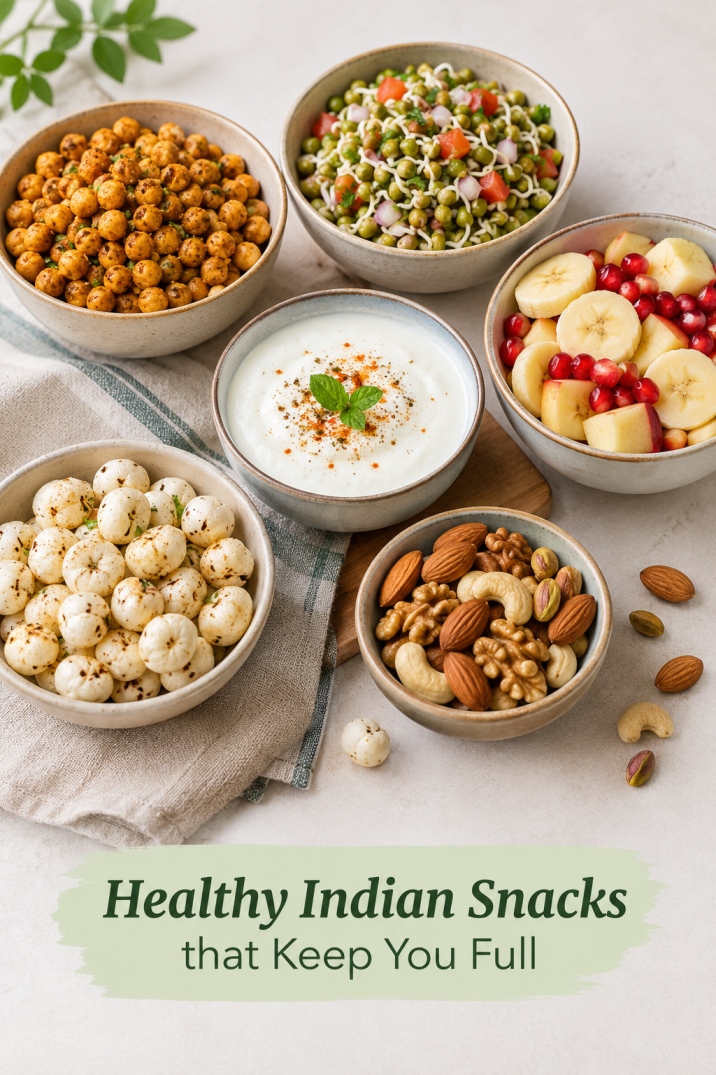
From roasted chana and sprouts to curd, fruit, makhana and nuts, there are plenty of practical options.
The goal is not to eliminate hunger.
The goal is to choose snacks that satisfy you and fit into your overall diet.
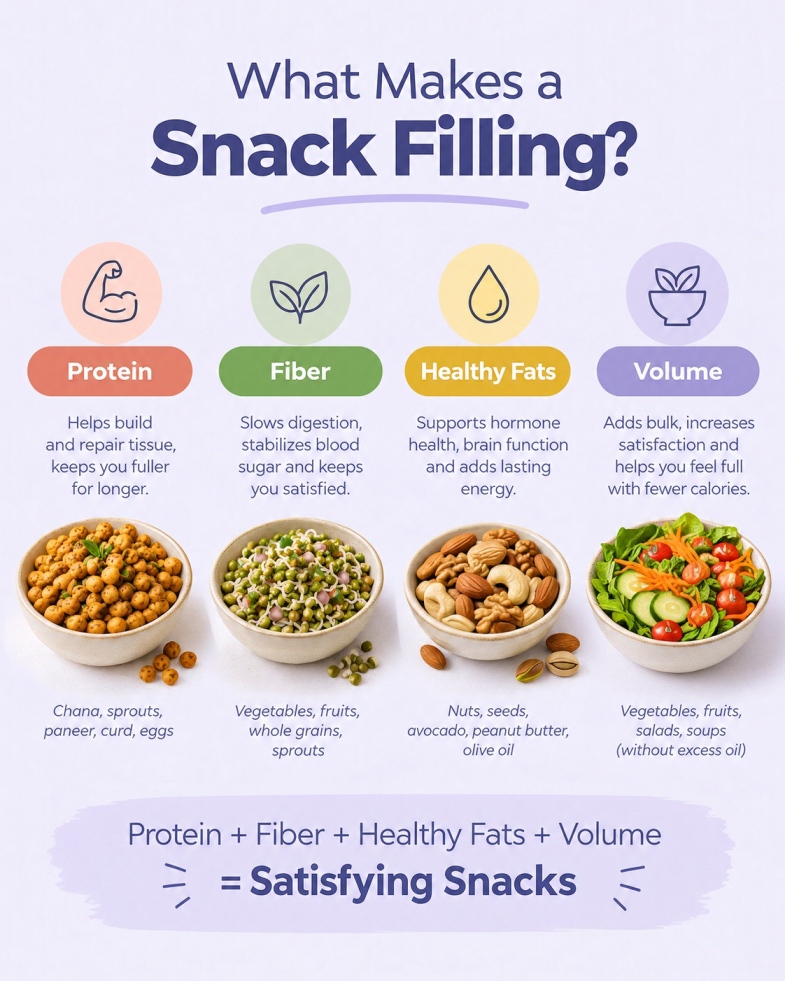
What Makes a Snack Filling?
A snack is more likely to keep you satisfied when it provides a useful combination of:
Protein
Fiber
Healthy fats
Food volume
Adequate energy
Good palatability
Protein and fiber are particularly useful because they can contribute to satiety.
For example:
Fruit alone can be nutritious.
But:
Fruit + curd
or
Fruit + a small portion of nuts
may provide a more substantial snack because you are combining different nutrients and textures.
Similarly:
Plain makhana
is different from:
Makhana + roasted chana
in terms of the overall nutrient profile.
The idea is simple:
Don't just ask, "Is this snack healthy?" Ask, "Will this snack actually satisfy me?"
https://nutritionsource.hsph.harvard.edu/what-should-you-eat/protein/
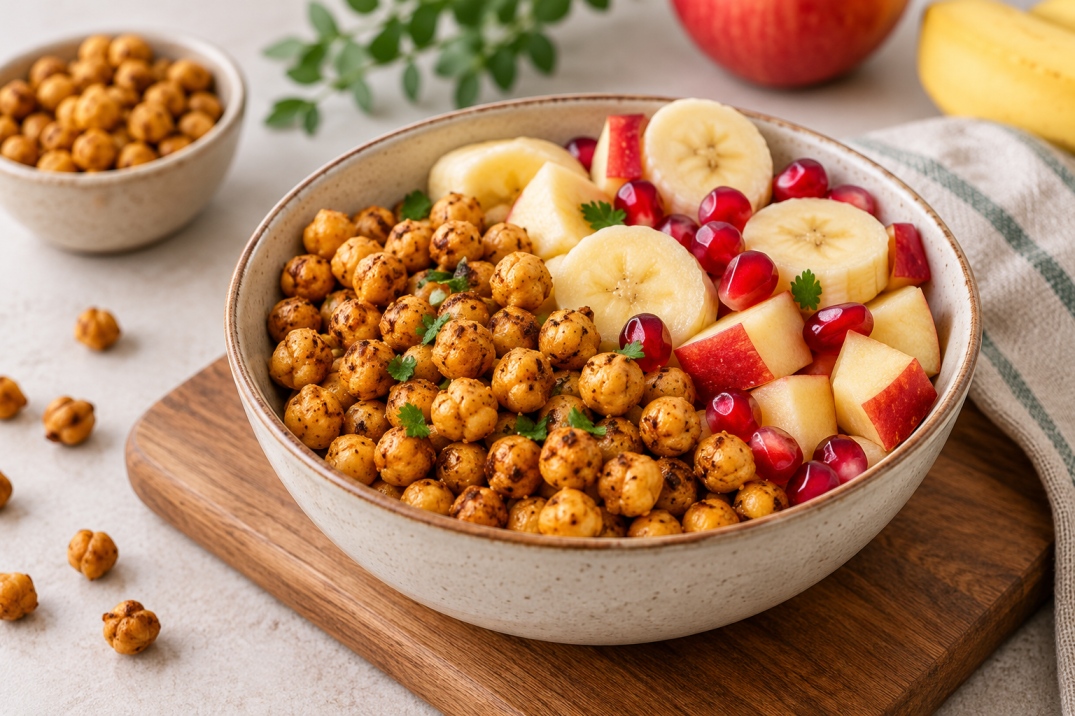
1. Roasted Chana
Roasted chana is one of the simplest Indian snacks to keep at home or carry to work.
It provides:
Protein
Fiber
Complex carbohydrates
Minerals
A satisfying crunchy texture
Portion idea
30–40 g roasted chana
You can pair it with:
Fruit
Unsweetened tea
Buttermilk
Easy combination
Roasted chana + guava
This combines protein, fiber and fruit.
2. Sprouts Chaat
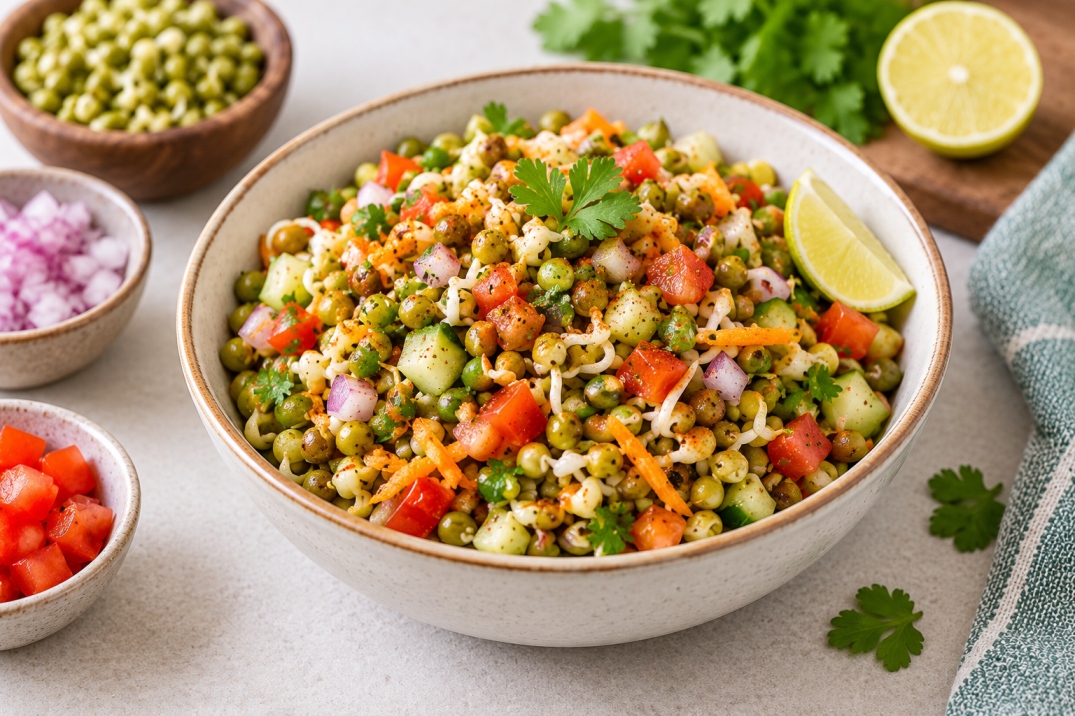
Sprouts can be an excellent snack when prepared with vegetables and simple seasonings.
Try:
Moong sprouts + tomato + cucumber + onion + lemon + coriander
You can also add a small amount of roasted peanuts for additional protein and healthy fats.
Why it works
The combination provides:
Plant protein
Fiber
Vegetables
Volume
Crunch
Micronutrients
Portion idea
1 medium bowl
If raw sprouts do not suit your digestion, lightly steam or cook them.
3. Curd + Fruit
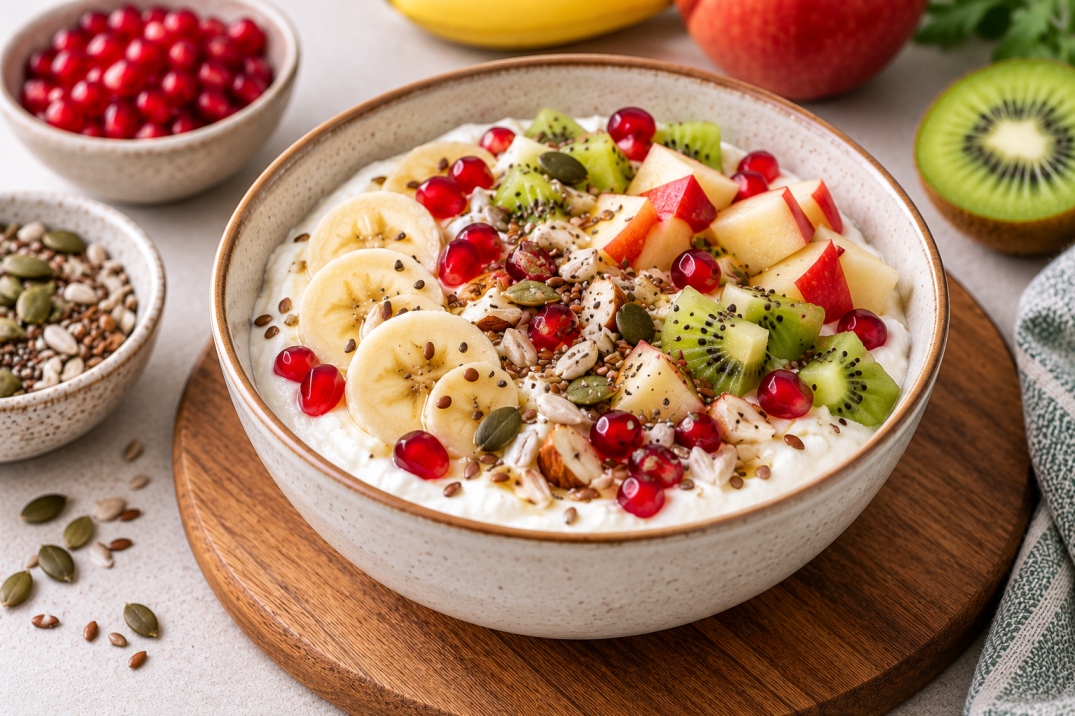
Curd is a convenient source of protein and calcium.
Combining it with fruit creates a simple snack that is more substantial than fruit alone.
Try:
150–200 g plain curd + 1 serving of fruit
Good combinations include:
Curd + apple
Curd + guava
Curd + papaya
Curd + pomegranate
Avoid turning it into a dessert by adding large amounts of sugar, honey or sweet syrups.
For additional texture, you can add a small amount of:
Chia seeds
Flaxseed powder
Nuts
4. Makhana
Makhana, or fox nuts, is a popular Indian snack option.
It is light and crunchy and can be roasted with minimal oil.
Simple preparation
Dry roast makhana and season with:
Black pepper
Roasted cumin
Turmeric
A small amount of salt
Portion idea
20–25 g roasted makhana
However, remember:
Makhana alone is not a high-protein snack.
If you are particularly hungry, combine it with a protein source such as:
Makhana + curd
or
Makhana + roasted chana
This makes the snack more balanced.
5. Fruit + Nuts
Fruit provides carbohydrates, fiber and various vitamins and plant compounds.
Nuts provide:
Protein
Unsaturated fats
Fiber
Minerals
Together, they can make a convenient snack.
Examples
Apple + 5–6 almonds
Guava + 2 walnuts
Orange + small handful of peanuts
Papaya + a few pumpkin seeds
Important
Nuts are nutritious but energy-dense.
A small portion is usually enough.
A common mistake is turning a healthy snack into a very high-calorie snack simply by eating nuts without portion awareness.
6. Moong Chilla
Who said chilla is only for breakfast?
A small moong chilla can make a filling evening snack.
Simple combination
1–2 small moong chillas + mint chutney + curd
This provides a combination of:
Protein
Fiber
Carbohydrates
Calcium
Volume
You can add vegetables such as:
Onion
Tomato
Spinach
Grated carrot
Capsicum
This also makes the snack more nutrient-dense.https://nutritionsource.hsph.harvard.edu/what-should-you-eat/protein/
7. Besan Chilla
Besan, made from chickpeas, can be used to prepare a quick savory snack.
Try:
1–2 small vegetable besan chillas + curd
Add:
Onion
Tomato
Coriander
Grated vegetables
Green chilli, if suitable
Use a controlled amount of oil for cooking.
This is particularly useful when you want something savory rather than sweet.
8. Boiled Eggs
For people who eat eggs, boiled eggs are one of the easiest protein-rich snack options.
Simple snack
1–2 boiled eggs + cucumber/tomato
You can season them with:
Black pepper
Lemon
Herbs
A small amount of salt
If you need something more substantial, pair them with:
1 small whole-wheat roti or toast
depending on your overall meal pattern.
9. Peanut Chaat
Peanuts can be a practical Indian snack when eaten in an appropriate portion.
Try:
Roasted peanuts + onion + tomato + coriander + lemon
You can add cucumber for extra volume.
Portion
Approximately 20–25 g peanuts can be a reasonable starting portion for many adults, depending on individual energy needs.
Peanuts are nutritious, but they are also energy-dense.
Healthy does not mean unlimited.
10. Dhokla with a Protein Side
Dhokla can fit into a healthy snack pattern.
Instead of treating it as a snack that must be avoided because it contains carbohydrates, look at the whole combination.
Try:
2 small pieces of dhokla + curd
or
Dhokla + sprouts/vegetable side
This provides a more balanced snack than eating several pieces of dhokla alone.
Choose preparations that are not heavily topped with oil or paired with large amounts of sugary chutney.
11. Homemade Poha
Poha does not have to be limited to breakfast.
A small bowl can work as an evening snack, especially when prepared with vegetables and peanuts.
Make it more filling with:
Peanuts
Peas
Vegetables
Coriander
Lemon
Portion
1 small bowl
If you are particularly hungry, include an additional protein source such as curd.
12. Vegetable Upma
A small bowl of vegetable upma can also work as a snack.
Improve its nutritional balance by adding:
Vegetables
Peanuts
Peas
Seeds, if suitable
Better combination
Vegetable upma + curd
This can be more satisfying than plain upma alone.
13. Boiled Corn Chaat
Corn can make a convenient snack when paired with vegetables.
Try:
Boiled corn + cucumber + tomato + coriander + lemon
You can add a small amount of roasted peanuts for additional protein and fat.
Avoid turning it into a heavily buttered or cheese-loaded snack if your goal is everyday hunger management.
14. Paneer + Vegetables
For a higher-protein snack, paneer can be paired with vegetables.
Try:
50–75 g paneer + cucumber/tomato/capsicum
You can lightly sauté the vegetables and paneer with spices.
This can be especially useful for people who become very hungry between lunch and dinner.
15. Buttermilk + Roasted Chana
This is a simple Indian combination that works well in hot weather.
Try:
1 glass unsweetened buttermilk + 25–30 g roasted chana
Buttermilk provides fluid and protein, while roasted chana adds protein, fiber and texture.
This can be particularly convenient for office workers.
16. Homemade Trail Mix
You can make your own snack mix instead of buying packaged trail mixes that may contain added sugar, excess salt or large quantities of dried fruit.
Simple homemade mix
Almonds
Walnuts
Roasted chana
Pumpkin seeds
Flaxseeds
Keep the portion controlled.
Portion idea
Small handful
The purpose is not to fill an entire container and snack directly from it.
Measure your portion first.
17. Sweet Potato Chaat
Sweet potato can be a satisfying carbohydrate-rich snack.
Try:
Boiled sweet potato + lemon + chaat masala + coriander
To make it more balanced, add:
A small amount of roasted peanuts or curd
This can be a useful alternative to biscuits or fried snacks.
18. Homemade Chana Chaat
Chana chaat is another filling option.
Ingredients
Boiled kala chana or kabuli chana
Tomato
Cucumber
Onion
Coriander
Lemon
Spices
Why it works
Chickpeas provide:
Plant protein
Fiber
Carbohydrates
Micronutrients
A medium bowl can make a substantial snack.
19. Vegetable Sandwich
A sandwich can absolutely be part of a healthy snack.
The key is what goes inside it.
Try:
Whole-wheat bread + paneer/egg + cucumber + tomato + lettuce
or
Whole-wheat bread + hummus + vegetables
The combination of whole grains, protein and vegetables can make the snack more satisfying.
20. Homemade Idli + Chutney
Small idlis can also be used as a snack.
Better approach
2 small idlis + sambar
Sambar adds pulses and vegetables, making the overall combination more substantial.
Instead of eating several idlis with only chutney, adding sambar can improve the protein and vegetable content of the snack.
The Snack Formula: Protein + Fiber + Volume
One of the easiest ways to build a more satisfying snack is to combine different food groups.
Formula
Protein + Fiber-rich food + Fruit/Vegetable
Examples:
Roasted chana + guava
Curd + fruit + seeds
Egg + cucumber
Paneer + vegetables
Sprouts + vegetables
Chana chaat + lemon
This approach is usually more useful than simply searching for the lowest-calorie snack.
Why "Low-Calorie" Doesn't Always Mean "Filling"
This is an important point for anyone trying to lose weight.
A snack can be low in calories but still leave you hungry.
For example:
A few plain crackers
may provide relatively little food volume and protein.
You may finish them and still want another snack shortly afterward.
Meanwhile:
Curd + fruit
or
roasted chana + fruit
may provide more protein, fiber and volume.
Weight management is not simply about choosing the smallest snack.
It is about choosing foods that help you manage your overall energy intake while maintaining adequate nutrition and satiety.
Why Protein Matters for Snack Satisfaction
Protein is generally more satiating than carbohydrate or fat when comparing foods under controlled conditions, although the overall meal composition and individual response matter.
Including a protein source can therefore be a useful strategy when you tend to become hungry soon after snacking.
Indian protein-rich snack options
Roasted chana
Sprouts
Curd
Paneer
Eggs
Besan chilla
Moong chilla
Soy chunks
Tofu
Chana chaat
Peanut-based snacks
You do not need protein bars or expensive packaged products to increase protein intake.https://wellorafit.com/services/nutrition-diet-planning/
Why Fiber Matters for Fullness
Fiber can contribute to satiety and also supports digestive health.
Indian fiber-rich snack foods include:
Fruits
Chana
Sprouts
Beans
Vegetables
Whole grains
Nuts
Seeds
A snack containing both protein and fiber can often be more satisfying than a snack made mostly from refined carbohydrates.
Healthy Snacks for Weight Loss: What to Look For
If your goal is weight management, look for snacks that are:
1. Nutrient-dense
They provide useful nutrients rather than mainly calories.
2. Protein-containing
Protein can help improve satiety.
3. Fiber-containing
Fiber adds volume and supports digestive health.
4. Portion-controlled
Even nutritious foods can contribute substantial calories when portions become very large.
5. Easy to repeat
The best snack is one you can realistically prepare and eat regularly.https://wellorafit.com/services/nutrition-diet-planning/
Healthy Office Snacks
Office hunger is often where snack choices become difficult.
You may have:
Biscuits
Namkeen
Sweets
Bakery products
Tea and coffee
Vending-machine snacks
Instead, keep a small snack kit.
Easy office options
Option 1: Roasted chana + fruit
Option 2: Nuts + fruit
Option 3: Roasted makhana + curd if refrigeration is available
Option 4: Homemade chana chaat
Option 5: Boiled eggs + cucumber
Option 6: Unsweetened buttermilk + roasted chana
Option 7: Homemade sandwich
Preparation matters.
If a healthier option is already available, you are more likely to choose it when hunger arrives.
What About Evening Hunger?
Many people experience strong hunger between 4–7 PM.
This can happen for several reasons:
Lunch was too small
Lunch lacked protein
Lunch lacked fiber
Long gap between meals
Increased physical activity
Poor sleep
Stress
Habitual snacking
Emotional eating
Simply being genuinely hungry
Instead of automatically suppressing the hunger, ask:
"Did I actually eat enough at lunch?"
If your lunch was:
1 roti + little sabzi
and you are extremely hungry by 5 PM, the problem may not be your snack.
Your main meal may need improvement.
When You May Not Need a Snack
Snacking is not mandatory.
If you are comfortably satisfied between meals, you do not need to eat simply because it is "snack time."
For example:
Breakfast → Lunch → Dinner
can work perfectly well for some people.
Others may genuinely need one or two snacks.
The appropriate pattern depends on:
Hunger
Meal size
Schedule
Physical activity
Work routine
Medical needs
Personal preference
Listen to hunger—but also look at the pattern.
Hunger vs Craving: Are They the Same?
Not always.
Physical hunger may:
Build gradually
Make many foods seem appealing
Occur several hours after a meal
Improve after eating
A craving may:
Appear suddenly
Be focused on one specific food
Occur even when you are physically full
Be associated with stress, boredom or habit
But this distinction is not always absolute.
You do not need to label every craving as "bad."
The goal is to understand your eating pattern without unnecessary guilt.
Common Snack Mistakes
Mistake 1: Only choosing "low-calorie" foods
A tiny snack may leave you hungry again very quickly.
Mistake 2: Eating directly from the packet
It becomes difficult to notice how much you have eaten.
Mistake 3: Assuming healthy foods are unlimited
Nuts, seeds, peanut butter and dried fruit are nutritious but energy-dense.
Mistake 4: Ignoring protein
Fruit alone may not be enough when you are genuinely hungry.
Mistake 5: Drinking calories without noticing
Sweetened tea, coffee, shakes and sugary beverages can add calories without providing much satiety.
Mistake 6: Calling every snack "cheating"
Food is not a moral test.
One snack does not determine your health.
Mistake 7: Trying to avoid all snacks during weight loss
If you are genuinely hungry, a planned nutritious snack may be more useful than trying to suppress hunger and eventually overeating.
15 Quick Indian Snack Combinations
Snack
Simple Combination
1
Roasted chana + guava
2
Curd + apple
3
Sprouts chaat + peanuts
4
Moong chilla + curd
5
Besan chilla + vegetables
6
Boiled egg + cucumber
7
Makhana + roasted chana
8
Peanut chaat + tomato
9
Paneer + vegetables
10
Buttermilk + roasted chana
11
Sweet potato + peanuts
12
Chana chaat
13
Vegetable sandwich + curd
14
Small vegetable poha + curd
15
Idli + sambar
A Simple Rule to Remember
Instead of asking:
"What is the lowest-calorie snack?"
Ask:
"What combination will satisfy my hunger while fitting into my overall diet?"
A practical starting point is:
Protein + Fiber + Volume
For example:
Curd + fruit
Chana + vegetables
Egg + vegetables
Moong chilla + curd
Paneer + vegetables
Roasted chana + fruit
These combinations can be much more satisfying than simply grabbing a packet of biscuits or namkeen.
The Bottom Line
Healthy snacking does not have to mean eating bland food or surviving on salads.
Indian cuisine already offers plenty of satisfying options.
Choose snacks built around:
Protein + fiber + vegetables/fruits + appropriate portions
and remember that overall dietary pattern matters more than one individual snack.
If you are hungry between meals, you do not have to feel guilty about eating.
Instead, make the snack work for you.
Choose something nutritious.
Eat an appropriate portion.
Eat it mindfully.
And move on with your day.
Key Takeaways
Snacking is not inherently unhealthy.
A filling snack usually works better when it contains protein, fiber and/or healthy fats.
Indian foods such as roasted chana, sprouts, curd, chilla, eggs, paneer, chana chaat and fruit can make nutritious snack choices.
Healthy foods still need appropriate portions.
Low-calorie does not always mean highly satisfying.
You do not need to snack if you are not hungry.
Strong evening hunger may sometimes indicate that your earlier meals were too small or lacked protein/fiber.
For weight management, focus on your overall dietary pattern rather than trying to make every snack as small as possible.
Keep convenient, nourishing options available at home and work.
A sustainable snack should be nutritious, satisfying and realistic for your routine.
Frequently Asked Questions
1. What are the healthiest Indian snacks?
Some nutritious options include roasted chana, sprouts chaat, curd with fruit, moong chilla, besan chilla, boiled eggs, chana chaat, paneer with vegetables, makhana and fruit with nuts.
2. Which Indian snacks keep you full the longest?
Snacks containing protein and fiber tend to be more satisfying than snacks made mainly from refined carbohydrates. Examples include chana chaat, moong chilla with curd, sprouts with peanuts and curd with fruit.
3. What is a good evening snack for weight loss?
A good evening snack should depend on your hunger and overall diet. Options such as roasted chana with fruit, curd with fruit, sprouts chaat or moong chilla with curd can work well.
4. Is makhana good for weight loss?
Makhana can fit into a weight-management diet, particularly when roasted with limited oil and eaten in an appropriate portion. However, it is not a high-protein food, so pairing it with curd or roasted chana can make the snack more balanced.
5. Is roasted chana a healthy snack?
Yes. Roasted chana provides protein, fiber and carbohydrates and can be a convenient snack option.
6. Can I eat fruit as a snack?
Absolutely. Fruit is a nutritious snack. If fruit alone does not keep you satisfied, pair it with curd, nuts or another suitable protein source.
7. Are nuts good for snacking?
Yes. Nuts provide unsaturated fats, protein, fiber and micronutrients. However, they are energy-dense, so portion control is important.
8. What should I eat when I am hungry between meals?
Choose a snack based on how hungry you are. For mild hunger, fruit may be enough. For stronger hunger, consider combinations such as curd + fruit, chana + fruit, sprouts + vegetables or chilla + curd.
9. Should I avoid snacks during weight loss?
Not necessarily. If you are genuinely hungry, a planned nutritious snack can fit into a weight-management diet.
10. What are good office snacks in India?
Roasted chana, fruit, nuts in measured portions, homemade chana chaat, roasted makhana, boiled eggs and homemade sandwiches can be practical office options.
11. Is poha a healthy snack?
Poha can be part of a healthy diet. Adding vegetables and peanuts and controlling the portion can improve its overall nutritional balance.
12. Is peanut chaat good for weight loss?
Peanut chaat can fit into a weight-management diet when the portion is appropriate. Add vegetables and lemon for volume and flavor.
13. Why am I hungry again soon after snacking?
You may be choosing a snack that is low in protein, fiber or overall food volume. Other factors such as meal size, sleep, stress, physical activity and eating habits can also affect hunger.
14. Is eating snacks at night unhealthy?
Not automatically. The overall diet, portion size and reason for eating matter more than simply the clock time. If you are genuinely hungry, a balanced snack can be appropriate.
15. How can I stop overeating snacks?
Start by identifying whether you are physically hungry or eating from habit, stress or boredom. Portion snacks before eating, avoid eating directly from large packets and choose combinations that provide protein and fiber.
Ready to Begin Your Health Journey?
Get a personalized, medically guided plan built around your unique biology.