Healthy Fats vs Unhealthy Fats: What’s the Difference?
For years, dietary fat was often treated as something that should simply be avoided.
You may have heard:
"Fat makes you fat."
"Avoid oil completely."
"Never eat ghee."
But nutrition is more complicated than that.
Fat is an essential nutrient. Your body needs dietary fat for important functions including cell structure, hormone-related processes, absorption of fat-soluble vitamins and energy. ICMR–NIN notes that lipids and fatty acids have important physiological and metabolic roles, including involvement in cell membranes, hormones and cell signalling.
The important question is therefore not:
"Should I eat fat?"
It is:
"What type of fat am I eating, how much am I eating, and what food is it replacing?"
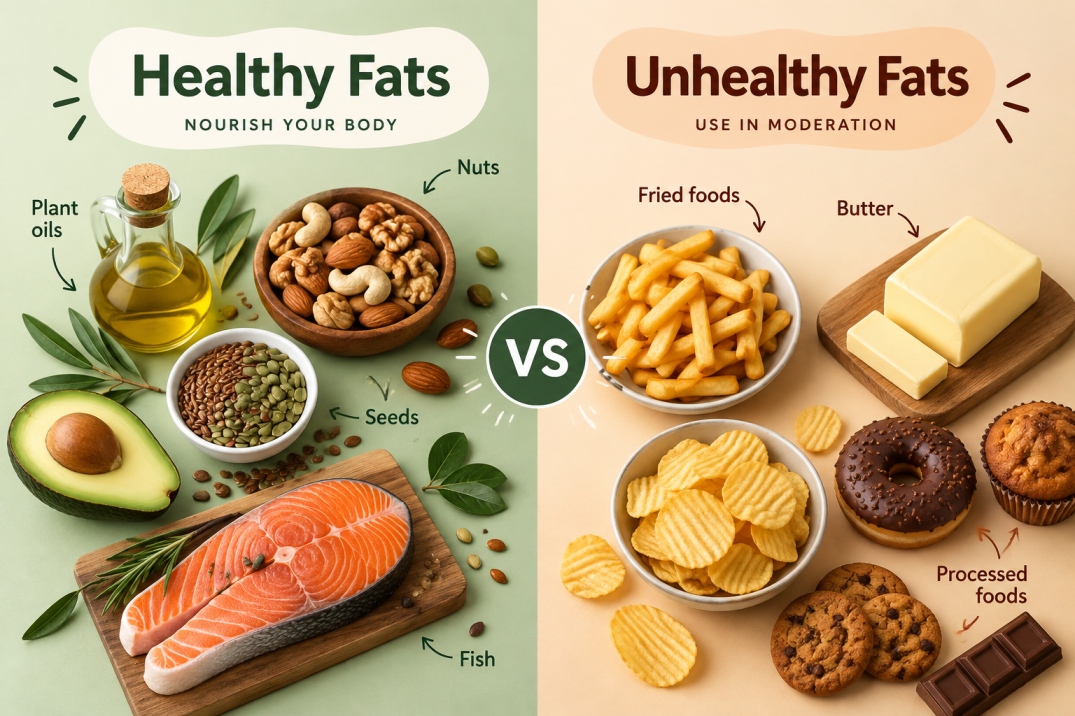
Some fats are generally more favourable for cardiovascular health, particularly unsaturated fats.
Other fats, especially industrially produced trans fats, should be avoided, while saturated fats should be limited. WHO recommends replacing saturated and trans fats with unsaturated fats where possible.
This becomes especially important in an Indian diet, where foods such as:
Ghee
Butter
Coconut
Mustard oil
Groundnut oil
Sesame seeds
Peanuts
Almonds
Walnuts
Fried snacks
can all appear regularly.
So, how do you know which fats to choose?
Let's break it down simply.https://www.nin.res.in/
Understanding Dietary Fat
What Is Dietary Fat?
Dietary fat is one of the three major macronutrients, along with carbohydrates and protein.
Fat provides energy and performs several important functions in the body.
It helps:
Provide energy
Form cell membranes
Support hormone-related functions
Absorb vitamins A, D, E and K
Provide essential fatty acids
Support normal brain and nervous system function
Add flavour and texture to food
Increase the satiety of meals
Because fat is energy-dense, however, relatively small quantities provide substantial calories.
This is why portion size matters even when the fat source is nutritious.https://www.nin.res.in/dietaryguidelines/
What Are the Different Types of Fat?
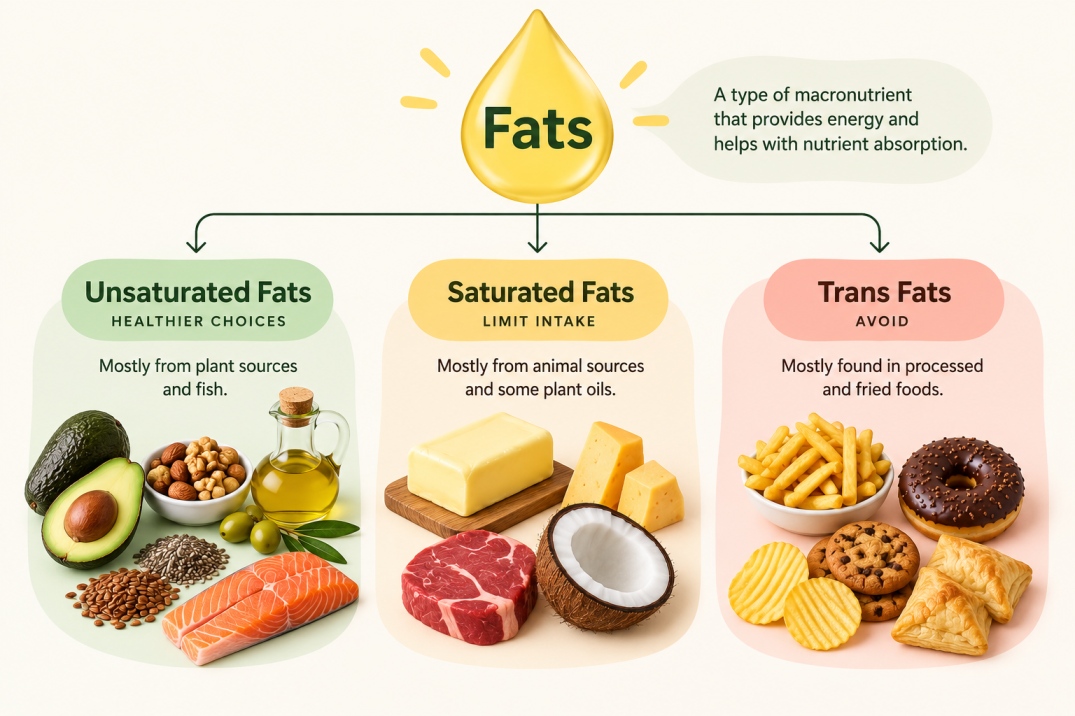
Dietary fats contain different types of fatty acids.
The main categories are:
1. Unsaturated fats
Monounsaturated fats (MUFA)
Polyunsaturated fats (PUFA)
2. Saturated fats
3. Trans fats
The effect of a food depends on its overall composition, preparation, quantity and the dietary pattern in which it is consumed.
1. Unsaturated Fats: The More Favourable Fats
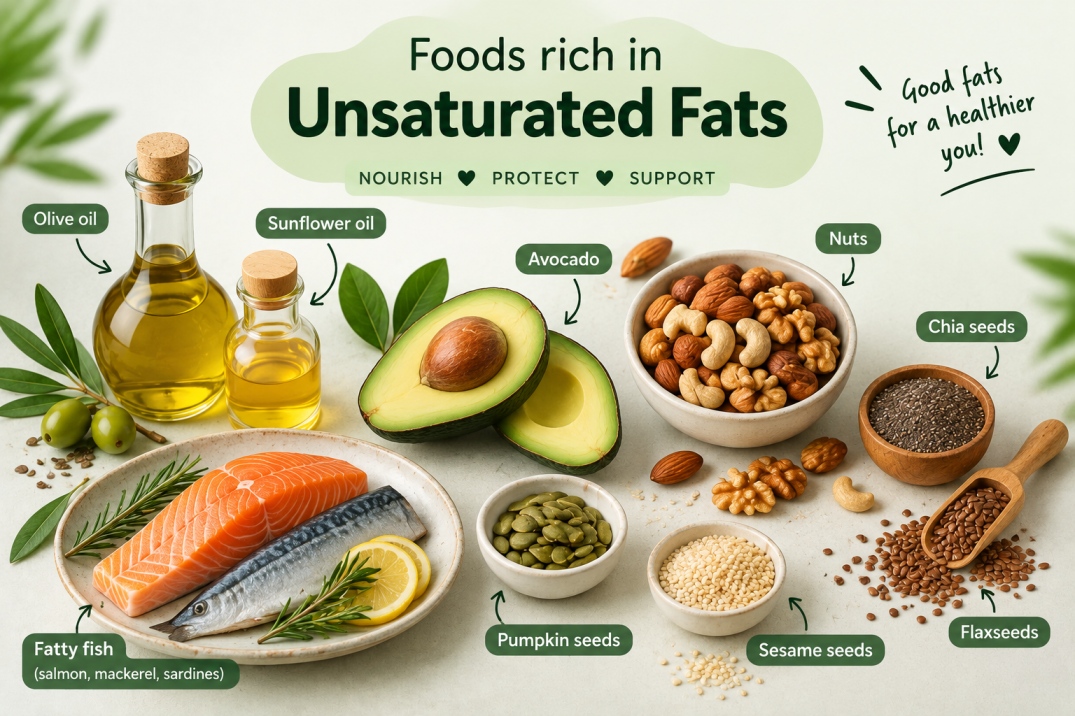
Unsaturated fats include:
Monounsaturated fats
Polyunsaturated fats
These are generally the fats you want to include more often in place of saturated fats, rather than thinking of them as foods you can eat without portion limits.
The American Heart Association recommends replacing foods high in saturated and trans fats with foods containing unsaturated fats.
Monounsaturated Fats (MUFA)
Monounsaturated fats are found in foods such as:
Peanuts
Groundnut oil
Almonds
Cashews
Avocado
Olive oil
Some other nuts and seeds
They can be part of a heart-friendly dietary pattern when they replace sources of saturated fat.
Indian Sources
Some practical Indian options include:
Peanuts
Groundnut oil
Sesame
Almonds
Cashews
Mustard oil
The goal is not to consume large amounts simply because a food contains MUFA.
It is about choosing better sources of fat while keeping total intake appropriate.
Polyunsaturated Fats (PUFA)
Polyunsaturated fats include important fatty acids such as:
Omega-3 fatty acids
Omega-6 fatty acids
Some of these fatty acids are essential, meaning the body cannot make enough of them and they need to come from food.
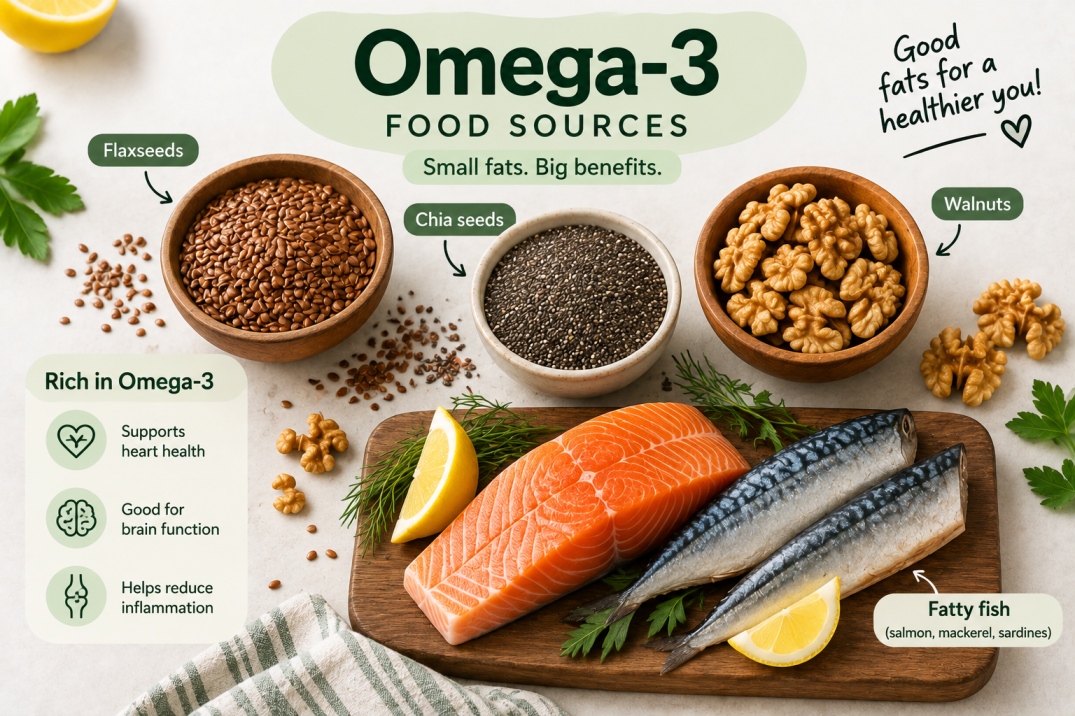
Sources of Omega-3 Fats
Plant sources include:
Flaxseeds
Chia seeds
Walnuts
Soybeans
Animal sources include:
Fatty fish such as salmon, sardines and mackerel
Sources of Omega-6 Fats
These can be found in:
Sunflower seeds
Sesame seeds
Soy
Nuts
Several vegetable oils
A varied diet can provide both omega-3 and omega-6 fatty acids.
2. Saturated Fats
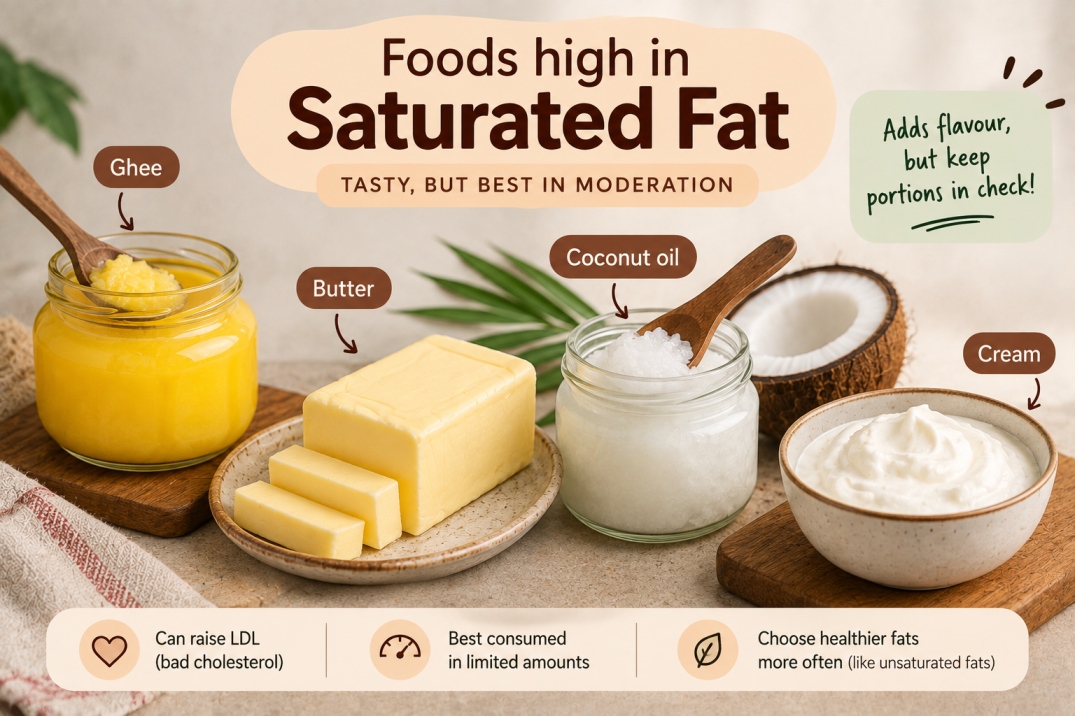
Saturated fats occur naturally in many foods.
Sources include:
Butter
Ghee
Cream
Full-fat dairy
Fatty meats
Coconut oil
Palm oil
This is where nutrition advice can become confusing.
You may see claims such as:
"Ghee is healthy."
or
"Coconut oil is natural, so it must be healthy."
Natural does not automatically mean that a food should be consumed without limits.
Ghee and coconut oil contain substantial amounts of saturated fat. WHO therefore lists butter, ghee, coconut and palm oils among important sources of saturated fat and recommends keeping saturated fat below 10% of total energy intake for adults.
Does This Mean You Must Never Eat Ghee?
No.
Ghee can be included in an Indian diet in appropriate amounts.
The important issue is quantity and overall dietary pattern.
For example:
A small amount of ghee with a balanced meal
is very different from:
Large amounts of ghee + butter + cream + fried foods every day.
3. Trans Fats: The Fats to Avoid
Trans fats deserve special attention.
Industrial trans fats are produced through processes such as partial hydrogenation and have been used in some processed and fried foods.
They can occur in:
Some baked goods
Certain packaged snacks
Shortening
Vanaspati
Some fried foods
WHO states that industrially produced trans fats are not part of a healthy diet and should be avoided. WHO recommends keeping total trans fat below 1% of daily energy intake.
Trans fats can adversely affect cholesterol levels and increase cardiovascular risk.
Practical Rule
Avoid industrial trans fats as much as possible.
When buying packaged foods, check the nutrition information and ingredients where applicable.
Saturated Fat vs Trans Fat
These two are often grouped together, but they are not identical.
Saturated Fat
Trans Fat
Naturally present in many foods
Can be industrially produced
Found in ghee, butter, coconut oil, fatty meats and dairy
Can occur in partially hydrogenated oils and some processed foods
Should be limited
Industrial trans fat should be avoided
Can raise LDL cholesterol when consumed in excess
Has particularly harmful cardiovascular effects
Can be part of foods eaten in moderation
No established health benefit for industrial trans fat
WHO recommends replacing saturated and trans fats with unsaturated fats where possible.
Why Does the Type of Fat Matter?
One reason is its effect on blood lipids and cardiovascular risk.
Replacing saturated fats with unsaturated fats can improve the overall fat quality of the diet.
For example:
Instead of frequently choosing
Butter-heavy preparation
↓
Consider
A preparation using an appropriate amount of unsaturated plant oil.
Similarly:
Instead of
Deep-fried packaged snacks
↓
Choose more often
Nuts, seeds, roasted legumes or other minimally processed options.
The important concept is:
Replace, don't simply add.
Replacing an unhealthy fat source with another high-calorie food does not automatically improve the diet.
Healthy Fat Sources in an Indian Diet
1. Nuts
Nuts provide:
Unsaturated fats
Protein
Fibre
Vitamins and minerals
Examples include:
Almonds
Walnuts
Peanuts
Pistachios
Cashews
Portion Matters
Nuts are nutritious but calorie-dense.
A small handful is very different from continuously snacking from a large packet.
2. Seeds
Seeds are another useful source of fats and other nutrients.
Try:
Flaxseeds
Chia seeds
Sesame seeds
Pumpkin seeds
Sunflower seeds
You can add them to:
Curd
Oatmeal
Dalia
Salads
Chutneys
Smoothies
3. Fatty Fish
For people who eat fish, fatty fish can provide long-chain omega-3 fatty acids.
Examples include:
Sardines
Mackerel
Salmon
Fish can be prepared using methods such as:
Grilling
Baking
Steaming
Light sautéing
rather than deep frying.
4. Plant Oils
Different plant oils have different fatty-acid compositions.
Examples include:
Mustard oil
Groundnut oil
Sesame oil
Sunflower oil
Soybean oil
Rice bran oil
Olive oil
There is no single cooking oil that needs to be labelled the "best oil for everyone."
The overall dietary pattern, amount used and fatty-acid profile matter.
Is Mustard Oil Healthy?
Mustard oil is commonly used in many Indian cuisines.
It contains a mixture of fatty acids, including monounsaturated and polyunsaturated fats.
It can be part of a balanced diet when used appropriately.
However, switching to mustard oil does not mean you can use unlimited quantities.
All cooking oils are energy-dense.
The amount used matters.
Is Groundnut Oil Healthy?
Groundnut oil contains a significant amount of monounsaturated fat along with other fatty acids.
It can be used as part of a balanced diet.
Again:
Healthy oil ≠ unlimited oil.
Is Olive Oil Better Than Indian Oils?
Olive oil is rich in monounsaturated fat, but that does not mean every Indian cooking oil needs to be replaced.
Mustard, groundnut, sesame, soybean and other oils can also fit into a healthy dietary pattern.
For Indian households, the more practical goal is often:
Use an appropriate amount of a suitable oil and avoid relying heavily on fried foods.
Is Ghee Healthy or Unhealthy?
The answer is more nuanced than simply saying "healthy" or "unhealthy."
Ghee is a source of fat and contains a high proportion of saturated fatty acids.
Therefore, it should not be treated as a free food.
A small amount can fit into many diets, but large quantities can substantially increase saturated fat and calorie intake.
WHO includes ghee among sources of saturated fat that should be limited.
Better approach
Use ghee as a flavouring fat rather than making it the major source of added fat in every meal.
Is Coconut Oil Healthy?
Coconut oil is often marketed as a health food.
However, coconut oil is high in saturated fat.
This does not mean it must be completely banned, but it should not automatically be considered equivalent to oils rich in unsaturated fats.
Use it according to your overall dietary pattern and in moderate quantities.
Healthy Fats and Weight Loss
One of the biggest myths about fat is:
"If I eat healthy fats, I will lose weight."
Healthy fats can be part of a weight-management diet, but they are still calorie-dense.
For example:
Nuts
Seeds
Oils
Nut butters
Avocado
Ghee
can all be nutritious while still contributing substantial calories.
For Weight Management
Focus on:
Quality + portion + total calorie intake
rather than simply increasing fat intake.https://wellorafit.com/services/nutrition-diet-planning/
How to Use Healthy Fats Without Overeating
Instead of pouring oil directly into the pan:
Measure it.
Instead of eating nuts directly from the packet:
Take a planned portion.
Instead of deep-frying vegetables:
Try roasting, grilling, sautéing or steaming.
Instead of adding multiple fats to one meal:
Choose a sensible combination.
For example:
Oil + nuts + seeds + ghee + fried food
can quickly make a meal very energy-dense.
Common Myths About Dietary Fat
Myth 1: All Fat Is Bad
Fact
Fat is an essential nutrient.
The important issue is the type and quantity of fat.
Myth 2: Healthy Fat Does Not Cause Weight Gain
Fact
All dietary fats provide substantial energy.
Even healthy fats can contribute to weight gain if consumed in excess.
Myth 3: Ghee Is Always Healthy Because It Is Traditional
Fact
Ghee can be part of a balanced diet, but it is high in saturated fat and should be consumed in moderation.
Myth 4: Coconut Oil Is Always Better Because It Is Natural
Fact
Coconut oil is high in saturated fat. Natural does not automatically mean unlimited or universally better.
Myth 5: Oil-Free Food Is Always Healthier
Fact
Dietary fat has important physiological functions.
The goal is not necessarily to eliminate fat, but to choose appropriate sources and quantities.
Myth 6: All Vegetable Oils Are Unhealthy
Fact
Many plant oils provide unsaturated fats and can be part of a healthy diet.
The amount used and overall dietary pattern matter.
Easy Indian Food Swaps for Better Fat Quality
Instead of frequent deep-fried snacks
Choose:
Roasted chana, peanuts, fruit or homemade snacks
Instead of repeated butter-heavy meals
Choose:
Meals prepared with an appropriate amount of unsaturated plant oil
Instead of deep-fried vegetables
Choose:
Sabzi cooked with moderate oil
Instead of fried papad
Choose:
Roasted papad occasionally
Instead of creamy desserts every day
Choose:
Fruit or plain/unsweetened curd
Instead of packaged fried snacks
Choose:
Nuts, seeds or roasted legumes in controlled portions
How Much Fat Should You Eat?
There is no single fat intake that is appropriate for every individual.
Requirements depend on:
Age
Sex
Energy needs
Activity level
Health status
Dietary pattern
WHO's current healthy-diet guidance states that adults can keep total fat at 30% or less of total energy intake to help prevent unhealthy weight gain, while saturated fat should remain below 10% and trans fat below 1% of total energy.
These are population-level recommendations and should not be treated as a personalized diet prescription.
A Simple Fat-Quality Checklist
Before adding fat to your meal, ask:
1. What is the source?
Nuts, seeds and plant oils are generally preferable to foods high in industrial trans fats.
2. What type of fat does it contain?
Look for more unsaturated fats and limit saturated fats.
3. How much am I using?
Even healthy fats need portion control.
4. What am I replacing?
Replacing butter with an unsaturated oil can be more meaningful than simply adding oil to the diet.
5. How is the food prepared?
Frequent deep frying can increase the energy density of meals.
A Balanced Indian Day With Better Fat Choices
Breakfast
Vegetable poha + peanuts + fruit
The peanuts add unsaturated fats and protein.
Mid-Morning
Fruit
Lunch
2 small rotis + dal + vegetable sabzi + curd + salad
Use an appropriate amount of cooking oil.
Evening
Roasted chana + a small portion of nuts
Dinner
Rice or millet + rajma/dal + vegetables + curd
This pattern provides fats from a variety of foods rather than relying heavily on fried foods or large quantities of added fats.https://wellorafit.com/services/nutrition-diet-planning/
Key Takeaways
Fat is an essential nutrient and should not be completely eliminated.
The type and quantity of fat both matter.
Unsaturated fats are generally preferred over saturated and trans fats.
Monounsaturated fats are found in foods such as peanuts, some nuts and seeds, and certain plant oils.
Polyunsaturated fats include essential fatty acids such as omega-3 and omega-6.
Ghee and coconut oil contain substantial amounts of saturated fat and should be used in moderation.
Industrial trans fats should be avoided.
Nuts, seeds and fatty fish can provide beneficial unsaturated fats.
Healthy fats are still calorie-dense, so portion control matters.
The best improvement is often to replace less favourable fats with more favourable fats, rather than simply adding more fat.
No single cooking oil is universally "best" for everyone.
A balanced Indian diet can include a variety of fats while keeping overall intake appropriate.
Conclusion
Fat is neither the enemy nor a magic health food.
Your body needs dietary fat, but the type, amount and source matter.
Unsaturated fats from foods such as nuts, seeds, fish and suitable plant oils can be valuable components of a balanced diet. Saturated fats from foods such as ghee, butter and coconut oil should be consumed in moderation, while industrial trans fats should be avoided. WHO and ICMR–NIN both emphasize improving fat quality and limiting harmful forms of fat.
For an Indian diet, this does not mean giving up traditional foods.
You can still enjoy:
Dal + roti + sabzi + a little ghee
or
Rice + rajma + vegetables + curd
while being mindful of how much oil, ghee and fried food are added throughout the day.
The goal is not:
"Eat no fat."
It is:
"Choose better fats, use appropriate portions, and build a balanced diet."
When you focus on the overall pattern rather than one individual ingredient, healthy eating becomes much simpler.
Good nutrition is not about fearing fat. It's about choosing the right kind, in the right amount, as part of a balanced diet.
FAQ
1. What are healthy fats?
Healthy fats generally refer to foods rich in unsaturated fats, particularly monounsaturated and polyunsaturated fats. Examples include nuts, seeds, some plant oils and fatty fish.
2. What are unhealthy fats?
The term commonly refers to saturated fats when consumed in excess and especially trans fats. Industrially produced trans fats are particularly harmful and should be avoided.
3. Is ghee a healthy fat?
Ghee can be included in a balanced diet in small amounts, but it is high in saturated fat. It should not be treated as an unlimited or universally superior fat source.
4. Is coconut oil healthy?
Coconut oil is high in saturated fat. It can be used in moderation, but it should not automatically be considered healthier than unsaturated plant oils.
5. Which Indian cooking oil is healthiest?
There is no single oil that is best for everyone. Mustard, groundnut, sesame, soybean, sunflower and other oils have different fatty-acid profiles. The amount used, overall diet and cooking practices also matter.
6. Are nuts healthy fats?
Nuts provide predominantly unsaturated fats along with protein, fibre and micronutrients. They are nutritious but calorie-dense, so portion size still matters.
7. Can I eat healthy fats while losing weight?
Yes. Healthy fats can be part of a weight-loss diet, but they still provide calories. Portion control and overall energy intake remain important.
8. Are saturated fats completely unhealthy?
Saturated fats occur naturally in many foods. Current dietary guidance recommends limiting them rather than treating them as a nutrient that must be completely eliminated. WHO recommends keeping saturated fat below 10% of total energy intake.
9. Why are trans fats considered unhealthy?
Trans fats, particularly industrially produced trans fats, increase cardiovascular risk and have no known health benefit. WHO recommends keeping total trans fat below 1% of total energy intake and avoiding industrial trans fats.
10. Is olive oil better than mustard or groundnut oil?
Olive oil is rich in monounsaturated fat, but mustard and groundnut oils can also fit into a healthy Indian diet. Rather than focusing on one "perfect" oil, focus on using an appropriate amount and limiting saturated and trans fats.
11. Should I completely stop eating fried food?
You do not necessarily need to eliminate every fried food, but frequent deep-fried foods can make the diet higher in energy and may contribute unhealthy fats depending on the food and cooking oil. ICMR–NIN recommends cooking methods such as sautéing, steaming, grilling, boiling or baking instead of frying more often.
12. What is the easiest way to improve fat quality?
Use nuts and seeds regularly in appropriate portions, choose suitable unsaturated plant oils, limit excess ghee and butter, and minimize fried and packaged foods that may contain industrial trans fats.
Ready to Begin Your Health Journey?
Get a personalized, medically guided plan built around your unique biology.